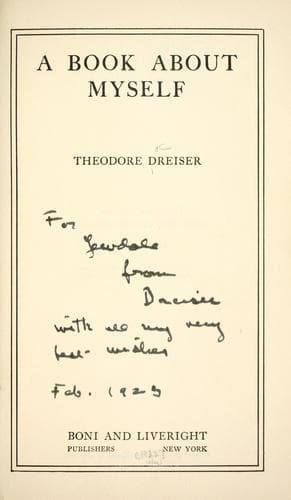
Dreiser, Theodore, 1871-1945; Journalists -- United States -- Biography; Novelists, American -- 20th century -- Biography
“You say you got thirty dollars there? I couldn’t pay anybody that much
here—not to begin with. We never give more than eighteen to begin with.
Besides, I have a full staff just now, and it’s summer. I might use
another man if eighteen would be enough. You might think it over and
come in and see me again some time.”
Although my spirits fell at so great a drop in salary I hastened to
explain that I would be glad to accept eighteen. I needed to be at work
again.
“Whatever you would consider fair would suit me,” I said.
He smiled. “The newspaper market is low just now. If your work proves
satisfactory I may raise you a little later on.” He must have seen that
he had a soft and more or less unsophisticated boy to deal with.
“Suppose you write me a little article about something, just to show me
what you can do,” he added.
I went away insulted by this last request. In spite of all he said I
could feel that he wanted me; but I had no skill in manipulating my own
affairs. To drop from thirty dollars as dramatic editor to eighteen as a
mere reporter was terrible. With a grain of philosophic melancholy I
faced it, however, feeling that if I worked hard I might yet get a start
in some way or other. I must work and save some money and if I did not
better myself I would leave St. Louis. My ability must be worth
something somewhere; it had been on the _Globe_.
I went home and wrote the article (a mere nothing about some street
scene), went back to the office and left it. Next day I called again.
“All right,” he said. “You can go to work.”
I went back into that large shabby room and took a seat. In a few
minutes the place filled up with the staff, most of whom I knew and all
of whom eyed me curiously—reporters, special editors, the city editor
and his assistant, Mr. Williams of blessed memory, one-eyed, sad,
impressive, intelligent, who had nothing but kind things to say of what
I wrote and who was friendly and helpful until the day I left.
In a little while the assignment book was put out, with the task I was
to undertake. Before I left I was called in and advised concerning it. I
went and looked into it (I have forgotten what it was) and reported
later in the day. What I wrote I turned over to Mr. Williams, and later
in the day when I asked him if it was all right he said: “Yes, quite all
right. It reads all right to me,” and then gave me a kindly, one-eyed
smile. I liked him from the first day; he was a better editor than
Wandell, with more taste and discrimination, and later rose to a higher
position elsewhere.
Meanwhile I strolled about thinking of my great fall. It seemed as
though I should never get over this. But in a few days I was back in my
old reportorial routine, depressed but secure, convinced that I could
write as well as ever, and for any newspaper.
Public-domain text, read in full here on John Shaqi.
Reviews
Reviews
No reviews yet
Be the first to share your thoughts on this work.
Elsewhere in the archive
Join the Discussion
Join the discussion
Sign in to leave a comment or review.
Sign InorCreate an account