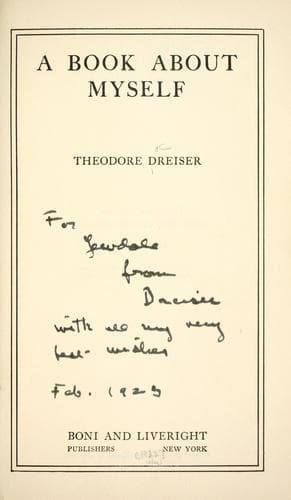
Dreiser, Theodore, 1871-1945; Journalists -- United States -- Biography; Novelists, American -- 20th century -- Biography
And how that reportorial room seemed to thrill or sing between the hours
of five and seven in the evening, when the stories of the afternoon were
coming in, or between ten-thirty and midnight, when the full grist of
the day was finally being ground out. How it throbbed with human life
and thought, quite like a mill room full of looms or a counting house in
which endless records and exchanges are being made. Those reporters,
eighteen or twenty of them, bright, cheerful, interesting, forceful
youths, each bent upon making a name for himself, each working hard,
each here bending over his desk scratching his head or ear and thinking,
his mind lost in the mazes of arrangement and composition.
Wandell had no tolerance for any but the best of newspaper reporters and
would discharge a man promptly for falling down on a story, especially
if he could connect it with the feeling that he was not as good a
newspaper man as he should be. He hated commonplace men, and once I had
become familiar with the office and with him, he would often ask me in a
spirit of unrest if I knew of an especially good one anywhere with whom
he could replace some one else whom he did not like; a thought which
jarred me but which did not prevent me from telling him. Somehow I had
an eye and a taste for exceptional men myself, and I wanted his staff to
be as good as any. So it was not long before he began to rely on me to
supply him with suitable men, so much so that I soon had the reputation
of being a local arbiter of jobs, one who could get men in or keep them
out—a thing which made me some enemies later. And it really was not true
for I could not have kept any good man out.
In the meantime, while he was trying me out to suit himself, he had been
giving me only routine work: the North Seventh Street police station
afternoons and evenings, where one or two interesting stories might be
expected every day, crimes or sordid romances of one kind or another. Or
if there was nothing much doing there I might be sent out on an
occasional crime story elsewhere. Once I had handled a few of these for
him, and to his satisfaction, I was pushed into the topnotch class and
given only the most difficult stories, those which might be called
feature crimes and sensations, which I was expected to unravel,
sometimes single-handed, and to which always I was expected to write the
lead. This realistic method of his plus a keen desire to unload all the
heavy assignments on me was in no wise bad for me. He liked me, and this
was his friendly way of showing it.
Public-domain text, read in full here on John Shaqi.
Reviews
Reviews
No reviews yet
Be the first to share your thoughts on this work.
Elsewhere in the archive
Join the Discussion
Join the discussion
Sign in to leave a comment or review.
Sign InorCreate an account