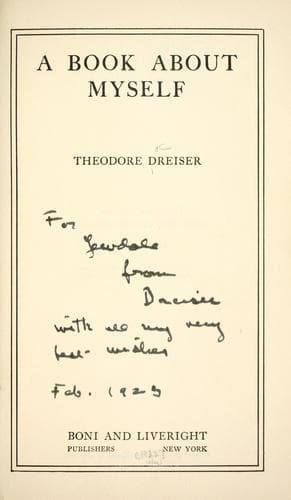
Dreiser, Theodore, 1871-1945; Journalists -- United States -- Biography; Novelists, American -- 20th century -- Biography
And quite truly I got him, as he was pleased to admit, even though I got
but little cash out of it. I always felt, perhaps unjustly, that he made
but small if any effort to advantage me in any way except that of
writing. But what of it? He was nearly always enthusiastic over my work,
in a hard, bright, waspish way, nearly always excited about the
glittering realistic facts which one might dig up and which he was quite
determined that his paper should present. The stories! The scandals!
That hard, cruel cackle of his when he had any one cornered! He must
have known what a sham and a fake most of these mid-Western pretensions
to sanctity and purity were, and yet if he did and was irritated by them
he said little to me. Like most Americans of the time, he was probably
confused by the endless clatter concerning personal perfection, the
Christ ideal, as opposed to the actual details of life. He could not
decide for himself which was true and which false, the Christ theory or
that of Zola, but he preferred Zola when interpreting the news. When
things were looking up from a news point of view and great realistic
facts were coming to the surface regardless of local sentiment, facts
which utterly contradicted all the noble fol-de-rol of the puritans and
the religionists, he was positively transformed. In those hours when the
loom of life seemed to be weaving brilliant dramatic or tragic patterns
of a realistic, Zolaesque character he was beside himself with gayety,
trotting to and fro in the local room, leaning over the shoulders of
scribbling scribes and interrupting them to ask details or to caution
them as to certain facts which they must or must not include, beaming at
the ceiling or floor, whistling, singing, rubbing his hands—a veritable
imp or faun of pleasure and enthusiasm. Deaths, murders, great social or
political scandals or upheavals, those things which presented the rough,
raw facts of life, as well as its tenderer aspects, seemed to throw him
into an ecstasy—not over the woes of others but over the fact that he
was to have an interesting paper tomorrow.
“Ah, it was a terrible thing, was it? He killed her in cold blood, you
say? There was a great crowd out there, was there? Well, well, write it
all up. Write it all up. It looks like a pretty good story to me—doesn’t
it to you? Write a good strong introduction for it, you know, all the
facts in the first paragraph, and then go on and tell your story. You
can have as much space for it as you want—a column, a column and a half,
two—just as it runs. Let me look at it before you turn it in, though.”
Then he would begin whistling or singing, or would walk up and down in
the city room rubbing his hands in obvious satisfaction.
Public-domain text, read in full here on John Shaqi.
Reviews
Reviews
No reviews yet
Be the first to share your thoughts on this work.
Elsewhere in the archive
Join the Discussion
Join the discussion
Sign in to leave a comment or review.
Sign InorCreate an account