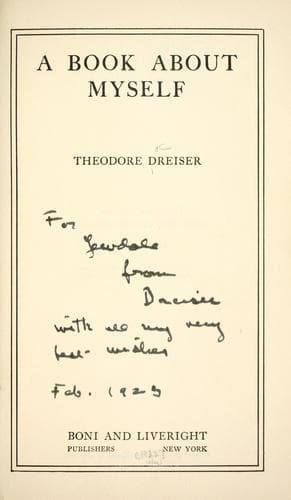
Dreiser, Theodore, 1871-1945; Journalists -- United States -- Biography; Novelists, American -- 20th century -- Biography
I am not familiar with many professions and so cannot say whether any of
the others abound in this same wealth of eccentric capacity and
understanding, or offer as little reward. Certainly all the newspaper
offices I have ever known sparkled with these exceptional men, few of
whom ever seemed to do very well, and no paper I ever worked on paid
wages anywhere near equal to the services rendered or the hours exacted.
It was always a hard, driving game, with the ash-heap as the reward for
the least weakening of energy or ability; and at the same time these
newspapers were constantly spouting editorially about kindness, justice,
charity, a full reward for labor, and were getting up fresh-air funds
and so on for those not half as deserving as their employees, but—and
this is the point—likely to bring them increased circulation. In the
short while I was in the newspaper profession I met many men who seemed
to be thoroughly sound intellectually, quite free, for the most part,
from the narrow, cramping conventions of their day, and yet they never
seemed to get on very well.
I remember one man in particular, Clark I think his name was, who
arrived on the scene just about this time and who fascinated me. He was
so able and sure of touch mentally and from an editorial point of view,
and yet financially and in every material way he was such a failure. He
came from Kansas City or Omaha while I was on the _Republic_ and had
worked in many, many places before that. He was a stocky, dark, clerkly
figure, with something of the manager or owner or leader about him, a
most shrewd and capable-looking person. And when he first came to the
_Republic_ he seemed destined to rise rapidly and never to want for
anything, so much self-control and force did he appear to have. He was a
hard worker, quiet, unostentatious, and once I had gained his
confidence, he gradually revealed a tale of past position and comfort
which, verified as it was by Wandell and Williams, was startling when
contrasted with his present position. Although he was not much over
forty he had been editor or managing editor of several important papers
in the West but had lost them through some primary disaster which had
caused him to take to drink—his wife’s unfaithfulness, I believe—and his
inability in recent years to stay sober for more than three months at a
stretch. In some other city he had been an important factor in politics.
Here he was, still clean and spruce apparently (when I first saw him, at
any rate), going about his work with a great deal of energy, writing the
most satisfactory newspaper stories; and then, once two or three months
of such labor had gone by, disappearing. When I inquired of Williams and
Wandell as to his whereabouts the former stared at me with his one eye
and smiled, then lifted his fingers in the shape of a glass to his
mouth. Wandell merely remarked: “Drink, I think. He may show up and he
may not. He had a few weeks’ wages when he left.”
Public-domain text, read in full here on John Shaqi.
Reviews
Reviews
No reviews yet
Be the first to share your thoughts on this work.
Elsewhere in the archive
Join the Discussion
Join the discussion
Sign in to leave a comment or review.
Sign InorCreate an account