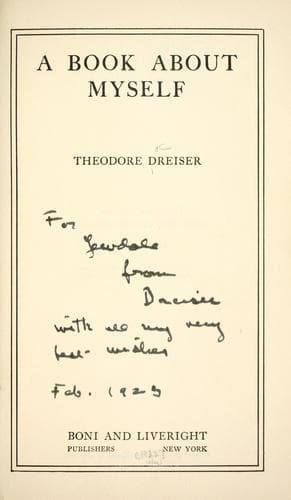
Dreiser, Theodore, 1871-1945; Journalists -- United States -- Biography; Novelists, American -- 20th century -- Biography
Let us say they came, a shabby, overworked mother or father leading a
recalcitrant boy or girl. King would assume a most ferocious air and
after listening to the complaint of the parent as if it were all news to
him would demand: “What’s ailin’ ye? Why can’t ye stay in nights? What’s
the matter with ye that ye can’t obey yer mother? Don’t ye know it’s
agin the laaw fer a minor to be stayin’ out aafter ten at night? Ye
don’t? Well, it is, an’ I’m tellin’ ye now. D’ye waant me t’lock ye up?
Is that what ye’re looking fer? There’s a lot av good iron cells back
there waitin’ fer ye if ye caan’t behave yerself. What’re ye goin’ t’do
about it?”
Possibly the one in error would relent a little and begin arguing with
the parent, charging unfairness, cruelty and the like.
“Here now, don’t ye be taalkin’ to yer mother like that! Ye’re not old
enough to be doin’ that. An’ what’s more, don’t let me ketch ye out on
the streets er her complainin’ to me again. If ye do I’ll send one av me
men around to bring ye in. This is the last now. D’ye waant to spend a
few nights in a cell? Well, then! Now be gettin’ out av here an’ don’t
let me hear any more about ye. Not a word. I’ve had enough now. Out with
ye!”
And he would glower and grow red and pop-eyed and fairly roar, shoving
them tempestuously out—only, after the victim had gone, he would lean
back in his chair and wipe his forehead and sigh: “’Tis tough, the
bringin’ up av childern, hereabouts especially. Ye can’t be blamin’ them
fer waantin’ to be out on the streets, an’ yet ye can’t let ’em out
aither, exactly. It’s hard to tell what to do with ’em. I’ve been
taalkin’ like that fer years now to one an’ another. ’Tis all the good
it does. Ye can’t do much fer ’em hereabouts.”
It was during this period, this summer time and fall, that I came in
contact with some of the most interesting characters, newspaper men
especially, flotsam and jetsam who drifted in here from other newspaper
centers and then drifted out again, newspaper men so intelligent and
definite in some respects that they seemed worthy of any position or
station in life and yet so indifferent and errant or so poorly placed in
spite of their efforts and capacities as to cause me to despair for the
reward of merit anywhere—intellectual merit, I mean. For some of these
men while fascinating were the rankest kind of failures, drunkards, drug
fiends, hypochondriacs. Many of them had stayed too long in the
profession, which is a young man’s game at best, and others had wasted
their opportunities dreaming of a chance fortune no doubt and then had
taken to drink or drugs. Still others, young men like myself, drifters
and uncertain as to their future, were just finding out how unprofitable
the newspaper game was and in consequence were cynical, waspish and
moody.
Public-domain text, read in full here on John Shaqi.
Reviews
Reviews
No reviews yet
Be the first to share your thoughts on this work.
Elsewhere in the archive
Join the Discussion
Join the discussion
Sign in to leave a comment or review.
Sign InorCreate an account