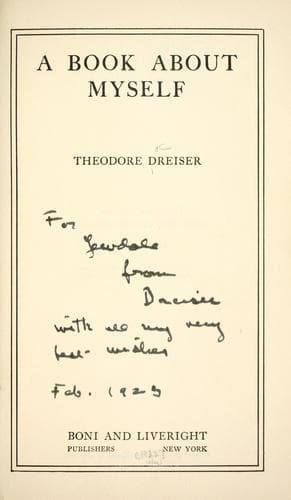
Dreiser, Theodore, 1871-1945; Journalists -- United States -- Biography; Novelists, American -- 20th century -- Biography
For my father, who was now seventy-two years of age, I had, all of a
sudden, as I have indicated above, the greatest sympathy. At home, up to
my seventeenth or eighteenth birthday, before I got out in the world and
began to make my own way, I had found him fussy, cranky, dosed with too
much religion; but in spite of all this and the quarrels and bickerings
which arose because of it there had always been something tender in his
views, charming, poetic and appreciative. Now I felt sorry for him. A
little while before and after my mother’s death it had seemed to me that
he had become unduly wild on the subject of the church and the
hereafter, was annoying us all with his persistent preachments
concerning duty, economy and the like, the need of living a clean,
saving, religious life. Now, after a year out in the world, with a
broadening knowledge of very different things, I saw him in an entirely
different light. While realizing that he was irritable, crotchety,
domineering, I suddenly saw him as just a broken old man whose hopes and
ambitions had come to nothing, whose religion, impossible as it was to
me, was still a comfort and a blessing to him. Here he was, alone, his
wife dead, his children scattered and not very much interested in him
any more.
Now that I was here in the city again, I decided that as soon as I could
arrange my other affairs I would go over on the west side and look him
up and bring him to see the Fair, which of course he had not seen. For I
knew that with his saving, worrying, almost penurious disposition he
would not be able to bring himself to endure the expense, even though
tickets were provided him, of visiting the Fair alone. He had had too
much trouble getting enough to live on in these latter years to permit
him to enjoy anything which cost money. I could hear him saying: “No,
no. I cannot afford it. We have too many debts.” He had not always been
so but time and many troubles had made the saving of money almost a
mania with him.
The next morning, therefore, I journeyed to the west side and finally
found him quite alone, as it chanced, the other members of the family
then living with him having gone out. I shall never forget how old he
looked after my year’s absence, how his eyelids twitched. After a
slightly quizzical and attempted hard examining glance at me his lips
twitched and tears welled to his eyes. He was so utterly done for, as he
knew, and dependent on the courtesy of his children and life. I cried
myself and rubbed his hands and his hair, then told him that I was doing
well and had come to take him to see the Fair, that I had tickets—a
passbook, no less—and that it shouldn’t cost him a penny. Naturally he
was surprised and glad to see me, so anxious to know if I still adhered
to the Catholic faith and went to confession and communion regularly. In
the old days this had been the main bone of contention between us.
Public-domain text, read in full here on John Shaqi.
Reviews
Reviews
No reviews yet
Be the first to share your thoughts on this work.
Elsewhere in the archive
Join the Discussion
Join the discussion
Sign in to leave a comment or review.
Sign InorCreate an account