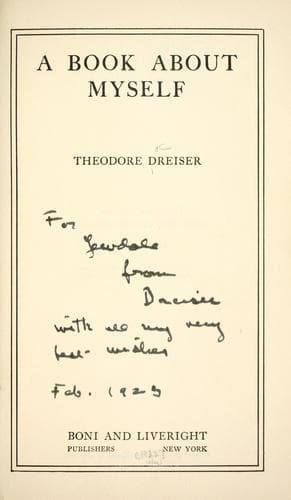
Dreiser, Theodore, 1871-1945; Journalists -- United States -- Biography; Novelists, American -- 20th century -- Biography
“Tell me, Dorsch,” he said not two minutes after I arrived, “do you
still keep up your church duties?”
When I hesitated for a moment, uncertain what to say, he went on: “You
ought to do that, you know. If you should die in a state of mortal
sin——”
“Yes, yes,” I interrupted, making up my mind to give him peace on this
score if I never did another thing in this world, “I always go right
along, once every month or six weeks.”
“You really do that, do you?” he asked, eyeing me more in appeal than
doubt, though judging by my obstinate past he must have doubted.
“Yes,” I insisted, “sure. I always go regularly.”
“I’m glad of that,” he went on hopefully. “I worry so. I think of you
and the rest of the children so much. You’re a young man now and out in
the world, and if you neglect your religious duties——” and he paused as
if in a grave quandary. “When you’re out like that I know it’s hard to
think of the church and your duties, but you shouldn’t neglect them——”
“Oh, Lord!” I thought. “Now he’s off again! This is the same old
story—religion, religion, religion!”
“But I do go,” I insisted. “You mustn’t worry about me.”
“I know,” he said, with a sudden catch in his voice, “but I can’t help
it. You know how it is with the other children: they don’t always do
right in that respect. Paul is away on the stage; I don’t know whether
he goes to church any more. A—— and E—— are here, but they don’t come
here much—I haven’t seen them in I don’t know how long—months——”
I resolved to plead with E—— and A—— when I saw them.
He was sitting in a big armchair facing a rear window, and now he took
my hand again and held it. Soon I felt hot tears on it.
“Pop,” I said, pulling his head against me and smoothing it, “you
mustn’t cry. Things aren’t so bad as all that. The children are all
right. We’ll probably be able to do better and more for you than we’ve
ever done.”
“I know, I know,” he said after a little while, overcoming his emotion,
“but I’m getting so old, and I don’t sleep much any more—just an hour or
two. I lie there and think. In the morning I get up at four sometimes
and make my coffee. Then the days are so long.”
I cried too. The long days ... the fading interests ... Mother gone and
the family broken up....
“I know,” I said. “I haven’t acted just right—none of us have. I’ll
write you from now on when I’m away, and send you some money once in a
while. I’m going to get you a big overcoat for next winter. And now I
want you to come over with me to the Fair. I’ve tickets, and you’ll
enjoy it. I’m a press representative now, a traveling correspondent.
I’ll show you everything.”
Public-domain text, read in full here on John Shaqi.
Reviews
Reviews
No reviews yet
Be the first to share your thoughts on this work.
Elsewhere in the archive
Join the Discussion
Join the discussion
Sign in to leave a comment or review.
Sign InorCreate an account