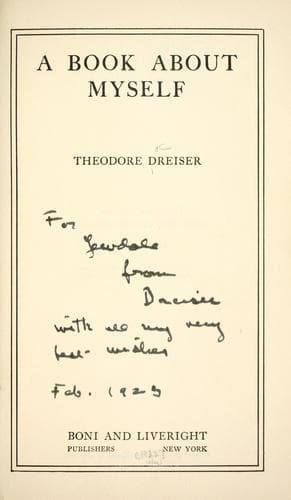
Dreiser, Theodore, 1871-1945; Journalists -- United States -- Biography; Novelists, American -- 20th century -- Biography
Yes, Alice saw something she wanted and thought she could hold. She
wanted to unite with me for this little span of existence, to go with me
hand in hand into the ultimate nothingness. I think she was a poet in
her way, but voiceless. When I called the first night she sat primly for
a little while on one of her red chairs near the window, while I
occupied a rocker. I had hung up my coat and hat with a flourish and had
stood about for a while examining everything, with the purpose of
estimating it and her. It all seemed cozy and pleasing enough and,
curiously, I felt more at ease on this my first visit than I ever did at
my Scotch maid’s home. There her thrifty, cautious, religious though
genial and well-meaning mother, her irritable blind uncle and her more
attractive young sister disturbed and tended to alienate me. Here, for
weeks and weeks, I never saw Alice’s foster-parents. When finally I was
introduced to them, they grated on me not at all. This first night she
played a little on her piano, then on her banjo, and because she seemed
especially charming to me I went over and stood behind her chair,
deciding to take her face in my hands and kiss her. Perhaps a touch of
remorse and in consequence a bit of indecision now swayed her, for she
got up before I could do it. On the instant my assurance became less and
yet my mood hardened, for I thought she was trifling with me. After the
previous Sunday it seemed to me that she could do no less than permit me
to embrace her. I was deciding that the evening was about to be a
failure, when she came up behind me and said: “Don’t you think it’s
rather nice across there, between those houses?”
Over the way a gap between peaked-roofed houses revealed a long stretch
of prairie, now covered with snow, gas lamps flickering in orderly rows,
an occasional frame house glowing in the distance.
“Yes,” I admitted moodily.
“This is a funny neighborhood,” she ventured. “People are always moving
in and out in that row of houses over there.”
“Are they?” I said, not very much interested now that I felt myself
defeated. There was a silence and then she laid one hand on my arm.
“You’re not mad at me, Dorse?” she asked, using a name which my sister
had given me.
The sound of it on her lips, soft and pleading, moved me.
“Oh, no,” I replied loftily. “Why should I be?”
“I was thinking that maybe I oughtn’t to be doing this. There’s been
some one else up to now, you know.”
“Yes.”
“I guess I don’t care for him any more or I wouldn’t be doing what I
am.”
“I thought you cared for me. Why did you invite me down here?”
“Oh, Dorse, I do,” she said, placing both her hands on my folded arms
and looking up into my face with a kind of tenseness. “I know it isn’t
right but I can’t help it. You have such nice hair and eyes, and you’re
so tall. Do you care for me at all?”
Public-domain text, read in full here on John Shaqi.
Reviews
Reviews
No reviews yet
Be the first to share your thoughts on this work.
Join the Discussion
Join the discussion
Sign in to leave a comment or review.
Sign InorCreate an account