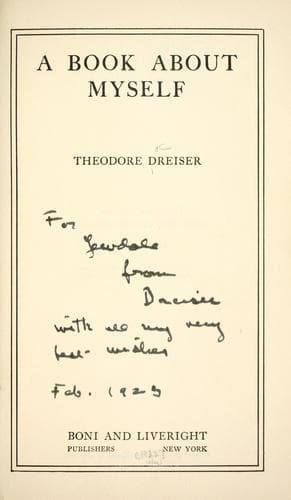
Dreiser, Theodore, 1871-1945; Journalists -- United States -- Biography; Novelists, American -- 20th century -- Biography
“What has become of your friend Miss W——?” she finally asked with a
touch of malice when I looked at her too kindly.
“I don’t know. I haven’t seen her since yesterday or the day before,”
which was not true. “What makes you ask that?”
“Oh, I thought you rather liked her,” she said boldly, throwing up her
chin and smiling.
“And what made you think it?” I asked calmly. It was in my mind that I
could master and deceive her as to this, and I proposed to try.
“Oh, I just thought so. You seemed to like her company.”
“Not any more than I do that of others,” I insisted with great
assurance. “She’s interesting, that’s all. I didn’t think I was showing
any preference.”
“Oh, I’m just joking,” she laughed. “I really don’t think anything about
it. One of the other girls made the remark.”
“Well, she’s wrong,” I said indifferently.
But I could see that she wasn’t joking. I could also see that I had
relieved her mind. My pose of indifference had quelled her feeling that
I was not wholly free. We sat and talked until dinner, and then I asked
her if she would like to go for a stroll in the park, to which she
agreed. By now we were obviously drifting toward each other emotionally,
and I thought how fine it would be to idle and dream with this girl in
the moonlight.
After dinner, when we started out, the air was soft and balmy and the
moon was just rising over the treetops in the East. A faint odor of
fresh flowers and fresh leaves was abroad and the night seemed to rest
in a soothing stillness. From the Midway came the sounds of muffled
drums and flutes, vibrant with the passion of the East. Before us were
the wide stretches of the park, dark and suggestive of intrigue where
groups of trees were gathered in silent, motionless array, in others
silvered by a fairy brightness which suggested a world of romance and
feeling.
I walked silently on with her, flooded with a voiceless feeling of
ecstasy. Now I was surely proving to myself that I was not entirely
helpless in the presence of girls. This time of idleness and moonlight
was in such smooth consonance with my most romantic wishes. She was not
so romantic, but the ardent luxury of her nature appeared to answer to
the romantic call of mine.
“Isn’t this wonderful?” I said at last, seeking to interest her.
“Yes,” she replied, almost practically. “I’ve been wondering why some of
the girls don’t come over here at night. It’s so wonderful. But I
suppose they’re tired.”
“They’re not as strong as you, that’s it. You’re so vigorous. I was
thinking today how healthy you look.”
“Were you? And I was just thinking what my mother would say if she knew
I was out here with a total stranger.”
“You told me you lived in St. Louis, I think?” I said.
“Yes, out in the north end. Near O’Fallon Park.”
“Well, then, I’ll get to see you when you go back,” I laughed.
“Oh, will you?” she returned coquettishly. “How do you know?”
“Well, won’t I?”
Public-domain text, read in full here on John Shaqi.
Reviews
Reviews
No reviews yet
Be the first to share your thoughts on this work.
Elsewhere in the archive
Join the Discussion
Join the discussion
Sign in to leave a comment or review.
Sign InorCreate an account