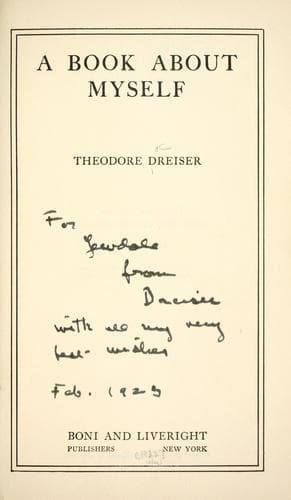
Dreiser, Theodore, 1871-1945; Journalists -- United States -- Biography; Novelists, American -- 20th century -- Biography
Once my work was done of an afternoon, I loitered over many things
waiting for evening to come, when I should see Alice again. Usually I
read or visited a gallery or some park. Alice was intensely sweet to me.
Her eyes were so soft, so liquid, so unprotesting and so unresenting.
She was usually gay, with at times a suggestion of hidden melancholy. At
night, in that great world of life which is the business heart of
Chicago I used to wait for her, and together, once we had found each
other in the crowds, we would make our way to the great railway station
at the end of Dearborn Street, where a tall clock-tower held a single
yellow clock-face. If it chanced to be Tuesday or Thursday I would go
home with her. On other nights she would sometimes stay down to dine
with me at some inexpensive place.
I never knew until toward the end of the following summer, when things
were breaking up for me in Chicago and seemingly greater opportunities
were calling me elsewhere, that during all this time she had really
never relinquished her relationship with my predecessor, fearing my
instability perhaps. By what necessary lies and innocent subterfuges she
had held him against the time when I might not care for her any more I
know not. The thing has poignance now. Was she unfaithful? I do not
think so. At any rate she was tender, clinging and in need of true
affection. She would take my hand and hold it under her arm or against
her heart and talk of the little things of the day: the strutting
customers and managers, the condescending women of social pretensions,
the other girls, who sometimes spied upon or traitorously betrayed each
other. Usually her stories were of amusing things, for she had no heart
for bitter contention. There was a note of melancholy running all
through her relationship with me, however, for I think she saw the
unrest and uncertainty of my point of view. Already my mind’s eye was
scanning a farther horizon, in which neither she nor any other woman had
a vital part. Fame, applause, power, possibly, these were luring me.
Once she said to me, her eyes looking longingly into mine:
“Do you really love me, Dorse?”
“Don’t you think I do?” I replied evasively, and yet saying to myself
that I truly cared for her in my fashion, which was true.
“Yes, I think you do, in your way,” she said, and the correct
interpretation shocked me. I saw myself a stormy petrel hanging over the
yellowish-black waves of life and never really resting anywhere. I could
not; my mind would not let me. I saw too much, felt too much, knew too
much. What was I, what any one, but a small bit of seaweed on an endless
sea, flotsam, jetsam, being moved hither and thither—by what
subterranean tides?
Oh, Alice, dead or living, eternally sleeping or eternally waking,
listen to these few true words! You were beautiful to me. My heart was
hungry. I wanted youth, I wanted beauty, I wanted sweetness, I wanted a
tender smile, wide eyes, loveliness—all these you had and gave.
Public-domain text, read in full here on John Shaqi.
Reviews
Reviews
No reviews yet
Be the first to share your thoughts on this work.
Join the Discussion
Join the discussion
Sign in to leave a comment or review.
Sign InorCreate an account