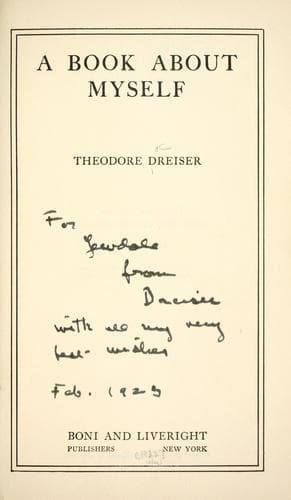
Dreiser, Theodore, 1871-1945; Journalists -- United States -- Biography; Novelists, American -- 20th century -- Biography
However the story was finally extracted, and a fine tale it made. It
appeared that up to seven or eight months preceding the robbery, this
robber had been first a freight brakeman or yard hand on this road,
later being promoted to the position of superior switchman and assistant
freight handler. Previous to this he had been a livery stable helper in
the town in which he was eventually taken, and before that a farm hand
in that neighborhood. About a year before the crime this road, along
with many others, had laid off a large number of men, including himself,
and reduced the wages of all others by as much as ten per cent.
Naturally a great deal of labor discontent ensued. A number of train
robberies, charged and traced to dismissed and dissatisfied
ex-employees, now followed. The methods of successful train robbing were
so clearly set forth by the newspapers that nearly any one so inclined
could follow them. Among other things, while working as a freight
handler, Lem Rollins had heard of the many money shipments made by the
express companies and the manner in which they were guarded. The
Missouri Pacific, for which he worked, was a very popular route for
money shipments, both West and East, bullion and bills being in transit
all the while between St. Louis and the East, and Kansas City and the
West, and although express messengers even at this time, owing to
numerous train robberies which had been occurring in the West lately
were always well armed, still these assaults had not been without
success. The death of firemen, engineers, messengers, conductors and
even passengers who ventured to protest, as well as the fact that much
money had recently been stolen and never recovered, had not only
encouraged the growth of banditry everywhere but had put such an
unreasoning fear into most employees of the road as well as its
passengers, who had no occasion for risking their lives in defense of
the roads, that but few even of those especially picked guards ventured
to give the marauders battle. I myself during the short time I had been
in St. Louis had helped report three such robberies in its immediate
vicinity, in all of which cases the bandits had escaped unharmed.
But the motives which eventually resulted in the amazing singlehanded
attempt of this particular robber were not so much that he was a
discharged and poor railroad hand unable to find any other form of
employment as that in his idleness, having wandered back to his native
region, he had fallen in love with a young girl. Here, being hard
pressed for cash and unable to make her such presents as he desired, he
had first begun to think seriously of some method of raising money, and
later, another ex—railroad hand showing up and proposing to rob a train,
he had at first rejected it as not feasible, not wishing to tie himself
up in a crime, especially with others; still later, his condition
becoming more pressing, he had begun to think of robbing a train on his
own account.
Public-domain text, read in full here on John Shaqi.
Reviews
Reviews
No reviews yet
Be the first to share your thoughts on this work.
Elsewhere in the archive
Join the Discussion
Join the discussion
Sign in to leave a comment or review.
Sign InorCreate an account