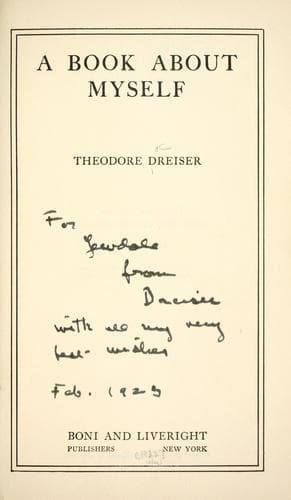
Dreiser, Theodore, 1871-1945; Journalists -- United States -- Biography; Novelists, American -- 20th century -- Biography
Why alone—that was the point we were all most anxious to find
out—singlehanded, and with all the odds against him? Neither Galvin nor
myself could induce him to make this point clear, although, once I
raised it, we were both most eager to solve it. “Didn’t he know that he
could not expect to overcome engineer and fireman, baggage-man and
mail-man, to say nothing of the express messenger, the conductor and the
passengers?”
Yes, he knew, only he had thought he could do it. Other bandits (so few
as three in one case of which he had read) had held up large trains; why
not one? Revolver shots fired about a train easily overawed all
passengers, as well as the trainmen apparently. It was a life and death
job either way, and it would be better for him if he worked it out alone
instead of with others. Often, he said, other men “squealed” or they had
girls who told on them. I looked at him, intensely interested and moved
to admiration by the sheer animal courage of it all, the “gall,” the
grit, or what you will, imbedded somewhere in this stocky frame.
And how came he to fix on this particular train? I asked. Well, it was
this way: Every Thursday and Friday a limited running west at midnight
carried larger shipments of money than on other days. This was due to
exchanges being made between Eastern and Western banks; but he did not
know that. Having decided on one of these trains, he proceeded by
degrees to secure first a small handbag, from which he had scraped all
evidence of the maker’s name, then later, from other distant places, so
as to avoid all chance of detection, six or seven fused sticks of giant
powder such as farmers use to blow up stumps, and still later, two
revolvers holding six cartridges each, some cartridges, and cord and
cloth out of which he proposed to make bundles of the money. Placing all
this in his bag, he eventually visited a small town nearest the spot
which, because of its loneliness, he had fixed on as the ideal place for
his crime, and then, reconnoitering it and its possibilities, finally
arranged all his plans to a nicety.
Public-domain text, read in full here on John Shaqi.
Reviews
Reviews
No reviews yet
Be the first to share your thoughts on this work.
Elsewhere in the archive
Join the Discussion
Join the discussion
Sign in to leave a comment or review.
Sign InorCreate an account