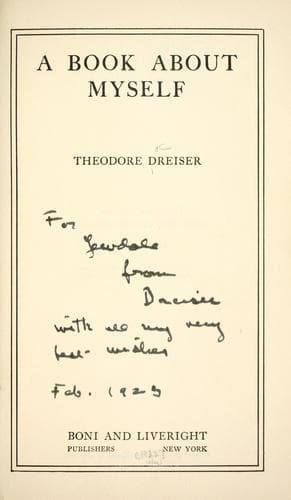
Dreiser, Theodore, 1871-1945; Journalists -- United States -- Biography; Novelists, American -- 20th century -- Biography
Here, as he now told us, just at the outskirts of this hamlet, stood a
large water-tank at which this express as well as nearly all other
trains stopped for water. Beyond it, about five miles, was a wood with a
marsh somewhere in its depths, an ideal place to bury his booty quickly.
The express was due at this tank at about one in the morning. The
nearest town beyond the wood was all of five miles away, a mere hamlet
like this one. His plan was to conceal himself near this tank and when
the train stopped, and just before it started again, to slip in between
the engine tender and the front baggage car, which was “blind” at both
ends. Another arrangement, carefully executed beforehand, was to take
his handbag (without the revolvers and sticks of giant powder, which he
would carry), and place it along the track just opposite that point in
the wood where he wished the train to stop. Here, once he had concealed
himself between the engine and the baggage car, and the train having
resumed its journey, he would keep watch until the headlight of the
engine revealed this bag lying beside the track, when he would rise up
and compel the engineer to stop the train. So far, so good.
However, as it turned out, two slight errors, one of forgetfulness and
one of eyesight, caused him finally to lose the fruit of his plan. On
the night in question, between eight and nine, he arrived on the scene
of action and did as he had planned. He put the bag in place and boarded
the train. However, on reaching the spot where he felt sure the bag
should be, he could not see it. Realizing that he was where he wished to
work he rose up, covered the two men in the cab, drove them before him
to the rear of the engine, where under duress they were made to uncouple
it, then conducted them to the express car door, where he presented them
with a stick of giant powder and, ordered them to blow it open. This
they did, the messenger within having first refused so to do. They were
driven into the car and made to ‘blow open the safe, throwing out the
packages of bills and coin as he commanded. But during this time,
realizing the danger of either trainmen or passengers climbing down from
the cars in the rear and coming forward, he had fired a few shots toward
the passenger coaches, calling to imaginary companions to keep watch
there. At the same time, to throw the fear of death into the minds of
both engineer and fireman, he pretended to be calling to imaginary
confrères on the other side of the train to “keep watch over there.”
“Don’t kill anybody unless you have to, boys,” he had said, or “That’ll
be all right, Frank. Stay over there. Watch that side. I’ll take care of
these two.” And then he would fire a few more shots.
Public-domain text, read in full here on John Shaqi.
Reviews
Reviews
No reviews yet
Be the first to share your thoughts on this work.
Elsewhere in the archive
Join the Discussion
Join the discussion
Sign in to leave a comment or review.
Sign InorCreate an account