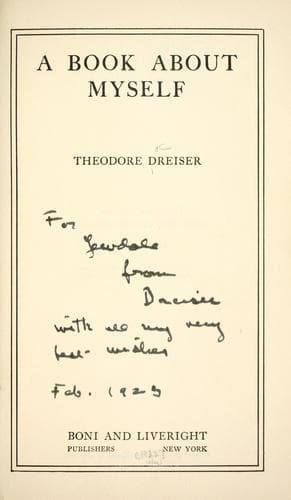
Dreiser, Theodore, 1871-1945; Journalists -- United States -- Biography; Novelists, American -- 20th century -- Biography
THINGS like these taught me not to depend too utterly on my own skill. I
might propose and believe, but there were things above my planning or
powers, and creatures I might choose to despise were not so helpless
after all. It fixed my thoughts permanently on the weakness of the human
mind as a directing organ. One might think till doomsday in terms of
human ideas, but apparently over and above ideas there were forces which
superseded or controlled them.... My own fine contemptuous ideas might
be superseded or set at naught by the raw animal or psychic force of a
man like Galvin.
During the next few months a number of things happened which seemed to
broaden my horizon considerably. For one thing, my trip to Chicago
having revived interest in me in the minds of a number of newspaper men
there, and having seemingly convinced them of my success here, I was
bombarded with letters from one and another wanting to know whether or
not they could obtain work here and whether I could and would aid them.
At the close of the Fair in Chicago in October hard times were expected
in newspaper circles there, so many men being released from work. I had
letters from at least four, one of whom was a hanger-on by the name of
Michaelson, of whom more anon, who had attached himself to me largely
because I was the stronger and he expected aid of me. I have often
thought how frequently this has happened to me—one of my typical
experiences, as it is of every one who begins to get along. It is so
much easier for the strong to tolerate the weak than the strong.
Strength craves sycophancy. We want only those who will swing the censer
before our ambitions and desires. Michaelson, or “Mich,” was a poor hack
who had been connected with a commercial agency where daily reports had
to be written out as to the financial and social condition of John Smith
the butcher, or George Jones the baker. This led Mich, who was a
farm-boy to begin with, to imagine that he could write and that he would
like to run a country paper, only he thought to get some experience in
the city first. By some process, of which I forget the steps, he fixed
on me; and through myself and McEnnis, who was then so friendly to me,
had secured a tryout on the _Globe_ in Chicago. After I left McEnnis
quickly tired of him, and I heard of him next as working for the City
Press, an organization which served all newspapers, and paid next to
nothing. Next I heard that he was married (having succeeded so well!),
and still later he began to bombard me with pleas for aid in getting a
place in St. Louis. Also there were letters from much better men: H. L.
Dunlap, afterwards chief press advisor of President Taft; an excellent
reporter by the name of Brady, whom I have previously mentioned; and a
little later, John Maxwell.
Public-domain text, read in full here on John Shaqi.
Reviews
Reviews
No reviews yet
Be the first to share your thoughts on this work.
Elsewhere in the archive
Join the Discussion
Join the discussion
Sign in to leave a comment or review.
Sign InorCreate an account