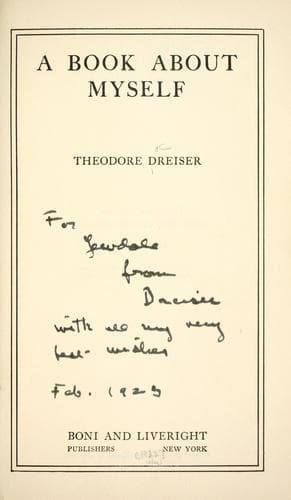
Dreiser, Theodore, 1871-1945; Journalists -- United States -- Biography; Novelists, American -- 20th century -- Biography
Meanwhile, in spite of my great failure in connection with Galvin, my
standing with Wandell seemed to rise rather than sink. Believe it or no,
I became a privileged character about this institution or its city room,
a singular thing in the newspaper profession. Because of specials I was
constantly writing for the Sunday paper, I was taken up by the sporting
editor, who wanted my occasional help in his work; the dramatic editor,
who wanted my help on his dramatic page, asking me to see plays from
time to time; and the managing editor himself, a small, courteous,
soft-spoken, red-headed man from Kansas City, who began to invite me to
lunch or dinner and talk to me as though I knew much (or ought to) about
the world he represented. I was so unfitted for all this intellectually,
my hour of stability and feeling for organization and control having not
yet arrived, that I scarcely knew how to manage it. I was nervous, shy,
poorly spoken, at least in their presence, while inwardly I was blazing
with ambition, vanity and self-confidence. I wanted nothing so much as
to be alone with my own desires and labors even though I believed all
the while that I did not and that I was lonely and neglected!
Unsophisticated as I really was, I began to see Wandell as but a minor
figure in this journalistic world, or but one of many, likely to be here
and gone tomorrow, and I swaggered about, taking liberties which months
before I should never have dreamed of taking. He talked to me too freely
and showed me that he relied on my advice and judgment and admired my
work. All out-of-town assignments of any importance were given to me.
Occasionally at seven in the evening he would say that he would buy me a
drink if I would wait a minute, a not very wise thing to do. Later,
after completing one big assignment or another, I would stroll out of
the office at, say, eight-thirty or nine without a word or a
by-your-leave, and so respectful had he become that instead of calling
me down in person he began writing me monitory letters, couched in the
most diplomatic language but insisting that I abide by the rules which
governed other reporters. But by now I had grown so in my own estimation
that I smiled confidently, knowing very well that he would not fire me;
my salary was too small. Besides, I knew that he really needed me or
some one like me and I saw no immediate rival anywhere, one who would
work as hard and for as little. Still I would reform for a time, or
would plead that the managing or the dramatic editor had asked me to do
thus and so.
“To hell with the managing editor!” he one day exclaimed in a rage.
“This is my department. If he wants you to sit around with him let him
come to me, or else you first see that you have my consent.”
Public-domain text, read in full here on John Shaqi.
Reviews
Reviews
No reviews yet
Be the first to share your thoughts on this work.
Elsewhere in the archive
Join the Discussion
Join the discussion
Sign in to leave a comment or review.
Sign InorCreate an account