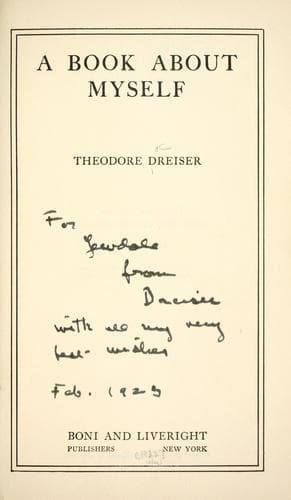
Dreiser, Theodore, 1871-1945; Journalists -- United States -- Biography; Novelists, American -- 20th century -- Biography
I knocked, and an attractive slip of a girl (her niece, as I learned)
answered. I was shown into a long, dustless, darkened parlor. After
giving me time to weigh the taste and affluence of her relatives
according to my standards, she arrived, the beloved, the beautiful. In
view of many later sadder things, it seems that here at least I might
attempt to do her full justice. She seemed exquisite to me then, a trim,
agreeable sylph of a girl, with a lovely oval face, stark red hair
braided and coiled after the fashion of a Greek head, a clear pink skin,
long, narrow, almond-shaped, gray-blue eyes, delicate, graceful hands, a
perfect figure, small well-formed feet. There was something of the wood
or water nymph about her, a seeking in her eyes, a breath of wild winds
in her hair, a scarlet glory to her mouth. And yet she was so obviously
a simple and inexperienced country girl, caught firm and fast in
American religious and puritanic traditions and with no hint in her mind
of all the wild, mad ways of the world. Sometimes I have grieved that
she ever met me, or that I so little understood myself as to have sought
her out.
I first saw her, after this long time, framed in a white doorway, and
she made a fascinating picture. Here, as in Chicago, she seemed shy,
innocent, questioning, as one who might fly at the first sound. I gazed
in admiration. Despite a certain something in her letters which had
indirectly assured me of her affection or her desire for mine, still she
held aloof, extending a cool hand and asking me to sit down, smiling
tenderly and graciously. I felt odd, out of place, and yet wonderfully
drawn to her, passionately interested. What followed by way of
conversation I cannot remember now—talk of the Fair, I suppose, some of
those we had known, her summer, mine. She took my roses and pinned some
of them on, placing the rest in a jar. There was a piano here, and after
a time she consented to play. In a moment, it seemed, it was
twelve-thirty, and I had to go.
I walked on air. It seemed to me that I had never seen any one more
beautiful—and I doubt now that I had. There was no reason to be applied
to the thing: it was plain infatuation, a burning, consuming desire for
her. If I had lost her then and there, or any time within a year
thereafter, I should have deemed it the most amazing affair of my life.
Public-domain text, read in full here on John Shaqi.
Reviews
Reviews
No reviews yet
Be the first to share your thoughts on this work.
Elsewhere in the archive
Join the Discussion
Join the discussion
Sign in to leave a comment or review.
Sign InorCreate an account