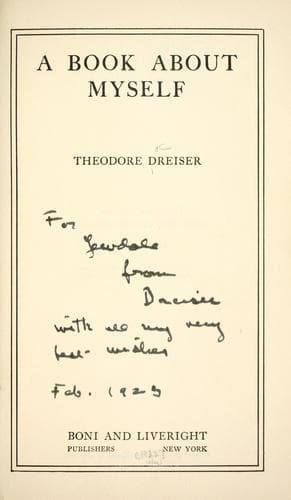
Dreiser, Theodore, 1871-1945; Journalists -- United States -- Biography; Novelists, American -- 20th century -- Biography
I returned to the office and took some assignment, which I cut short at
three-thirty in order to get back to the Grand Opera House to sit beside
her. The play was an Irish love drama, with Chauncey Olcott, the singing
comedian, in the title rôle. With her beside me I thought it perfect.
Love! Ah, love! When the performance was ended I was ready to weep over
the torturing beauty of life. Outside we found the matinée crowds, the
carriages, the sense of autumn gayety and show in the air. A nearby
ice-cream and candy store was crowded to suffocation. Young girls of the
better families hummed like bees. Because of my poverty and uncertain
station I felt depressed, at the same time pretending to a station which
I felt to be most unreal. The mixture of ambition and uncertainty,
pride, a gay coaxing in the air, added to the need to return to
conventional toil—how these tortured me! Nothing surprises me now more
than my driving emotions all through this period. I was as one
possessed.
We parted at a street-car—when I wanted a carriage! We met at her aunt’s
home at eight-thirty, because I saw an opportunity of deliberately
evading an assignment. In this simple parlor I dreamed the wildest, the
most fantastic dreams. She was the be-all and the end-all of my
existence. Now I must work for her, wait for her, succeed for her! Her
mediocre piano technique seemed perfect, her voice ideal! Never was such
beauty, such color. St. Louis took on a glamour which it had never
before possessed.... If only this love affair could have gone on to a
swift fruition it would have been perfect, blinding.
But all the formalities, traditions, beliefs, of a conventional and
puritanic region were in the way. Love, as it is in most places, and
despite its consuming blaze, was a slow process. There must be many such
visits, I knew, before I could even place an arm about her. I was to be
permitted to take her to church, to concerts, the theater, a restaurant
occasionally, but nothing more.
The next morning I went to church with her; the next afternoon
unavoidable work kept me from her, but that night I shirked and stayed
with her until eleven. The next morning, since she had to catch an early
train for Florissant, I slept late, but during the next two weeks (she
could not come oftener, having to spend one Sunday with her “folks,” as
she referred to them) I poured forth my amazement and delight on reams
of thin paper. I wonder now where they are. Once there was a trunk full.
Public-domain text, read in full here on John Shaqi.
Reviews
Reviews
No reviews yet
Be the first to share your thoughts on this work.
Elsewhere in the archive
Join the Discussion
Join the discussion
Sign in to leave a comment or review.
Sign InorCreate an account