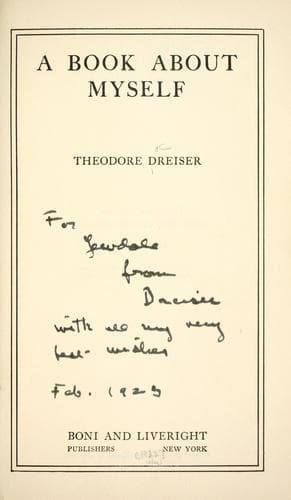
Dreiser, Theodore, 1871-1945; Journalists -- United States -- Biography; Novelists, American -- 20th century -- Biography
Yet I walked on to the main corner and inquired where my friend lived,
then out a country road indicated to me as leading toward his home. I
found an old rambling frame house, facing the Maumee River, with a
lean-to and kitchen and springhouse, corncribs, a barn twice the size of
the house, and smaller buildings, all resting comfortably on a rise of
ground. Apple and pear trees surrounded it, now leafless in the wind. A
curl of smoke rose from the lean-to and told me where the cookstove was.
As I entered the front gate I felt the joy of a country home. It told of
simple and plain things, food, warmth, comfort, minds content with
routine. Michaelson appeared at the door and greeted me most
enthusiastically. He introduced me to his family with the exuberant
youthfulness of a schoolboy.
I met the father, a little old dried-up quizzical man, who looked at me
over his glasses in a wondering way and rubbed his mouth with the back
of his hand. I met the mother, small, wizened, middle-aged, looking as
though she had gone through a thousand worries. Then I met Michaelson’s
wife, a dark, chubby, brown-skinned woman, stocky and not
over-intelligent. They asked me to make myself at home, listened to an
account of my experiences in getting there, and then Michaelson
volunteered to show me about the place.
My mind revolted at the thought of such a humdrum life as this for
myself, though I was constantly touched by its charm—for others. I
followed the elder Mrs. Michaelson into the lean-to and watched her
cook, went with Michaelson to the barn to look over the live stock and
returned to talk with Michaelson senior about the prospects of the
Republican party in Ohio. He was much interested in a man named
McKinley, a politician of Ohio, who had been a congressman for years and
who was now being talked of as the next candidate of the Republican
party for the Presidency. I had scarcely heard of him up to that time,
but I gave my host my opinion, such as it was. We sat about the big drum
sheet-iron stove, heated by natural gas, then but newly discovered and
piped in that region. After dinner I proposed to my friend that we go
into the village and inspect the printing plant which he had said was
for sale. We walked along the road discussing the possibilities, and it
seemed to me as we walked that he was not as enthusiastic as he had been
in St. Louis.
“I’ve been looking at this fellow’s plant,” he said vaguely, “and I
don’t know whether I want to give him two hundred down for it. He hasn’t
got anything. That old press he has is in pretty bad shape, and his type
is all worn down.”
“Can we get it for two hundred?” I asked innocently.
“Sure, two hundred down. I wouldn’t think of giving him more. All he
wants now is enough to get out of here, some one to take it off his
hands. He can’t run it.”
Public-domain text, read in full here on John Shaqi.
Reviews
Reviews
No reviews yet
Be the first to share your thoughts on this work.
Elsewhere in the archive
Join the Discussion
Join the discussion
Sign in to leave a comment or review.
Sign InorCreate an account