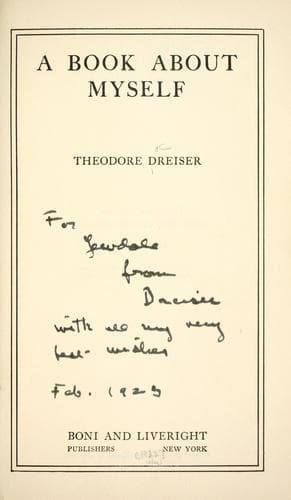
Dreiser, Theodore, 1871-1945; Journalists -- United States -- Biography; Novelists, American -- 20th century -- Biography
We went to the office of the _Herald_, a long dark loft over a feed
store, and found there a press and some stands of type, and a table
before the two front windows, which looked west. The place was unlighted
except by these windows and two in the back, and contained no provision
for artificial light except two or three tin kerosene lamps. Slazey, the
youthful editor, was not in. We walked about and examined the contents
of the room, all run down. The town was small and slow, and even an
idealist could see that there was small room here for a career.
Presently the proprietor returned, and I saw a sad specimen of the
country editor of those days: sleepy, sickly-looking, with a spare,
gaunt face and a head which had the appearance of an egg with the point
turned to the back. His hair was long and straight and thin, the back
part of it growing down over his dusty coat-collar. He wore a pair of
baggy trousers of no shape or distinguishable color, and his coat and
waistcoat were greasy. He extended a damp, indifferent hand to me.
“I hear you want to sell out,” I said.
“Yes, I’m willing to sell,” he replied sadly.
“Do you mind showing us what you have here?”
He went about mechanically, and pointed out the press and type and some
paper he had on hand.
“Let me see that list of subscribers you showed me the other day,” said
Michaelson, who now seemed eager to convince himself that there might be
something in this affair.
Slazey brought it out from an old drawer and together we examined it,
spreading it out on the dusty table and looking at the names checked off
as paid. There were not more than a thousand. Some of them had another
mark beside the check, and this excited my curiosity.
“What’s this cross here for?”
“That’s the one that’s paid for this year.”
“Isn’t this this year’s list?”
“No. I just thought I’d check up the new payments on the old list. I
haven’t had time to make out a new one.”
Our faces fell. The names checked with a cross did not aggregate five
hundred.
“I’ll tell you what we’d better do,” observed Michaelson heavily,
probably feeling that I had become suddenly depressed. “Suppose we go
around and see some of the merchants and ask them if they’ll support us
with advertising?”
I agreed, feeling all the while that the whole venture was ridiculous,
and together we went about among the silent stores, talking with
conservative men, who represented all that was discouraging and
wearisome in life. Here they stood all day long calculating in pennies
and dimes, whereas the city merchant counted in hundreds and thousands.
It was dispiriting. Think of living in a place like this, among such
people!
Public-domain text, read in full here on John Shaqi.
Reviews
Reviews
No reviews yet
Be the first to share your thoughts on this work.
Elsewhere in the archive
Join the Discussion
Join the discussion
Sign in to leave a comment or review.
Sign InorCreate an account