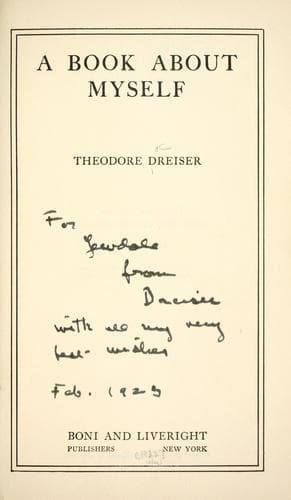
Dreiser, Theodore, 1871-1945; Journalists -- United States -- Biography; Novelists, American -- 20th century -- Biography
“I might give a good paper my support,” said one, a long, lean,
sanctimonious man who looked as though he had narrow notions and a firm
determination to rule in his small world. “But it’s mighty hard to make
a paper that would suit this community. We’re religious and hard-working
here, and we like the things that interest religious and hard-working
people. Course if it was run right it might pay pretty well, but I dunno
as ’twould neither. You never can tell.”
I saw that he would be one hard customer to deal with anyhow. If there
were many like him—— The poor, thin-blooded, calculating world which he
represented frightened me.
“How much advertising do you think you could give to a paper that was
‘run’ right?”
“Well, that depends,” he said gloomily and disinterestedly. “I’d have to
see how it was run first. Some weeks I might give more than others.”
Michaelson nudged me and we left.
“I forgot to tell you,” he said, “that he’s a Baptist and a Republican.
He’d expect you to run it in favor of those institutions if you got his
support. But all the men around town won’t feel that way.”
In the dusty back room of a drugstore we found a chemist who did not
know whether a weekly newspaper was of any value to him, and could not
contribute more than fifty cents a week in advertising if it were. The
proprietor of the village hotel, a thick-set, red-faced man with the air
of a country evil-doer, said that he did not see that a local newspaper
was particularly valuable to him. He might advertise, but it would be
more as a favor than anything else.
I began to sum up the difficulties of our position. We should be
handicapped, to begin with, by a wretched printing outfit. We should be
beholden to a company of small, lean-living, narrow men who would take
offense at the least show of individuality and cut us off entirely from
support. We should have to busy ourselves gathering trivial items of
news, dunning hard-working, indifferent farmers for small amounts of
money, and reduce all our thoughts and ambitions to the measure of this
narrow world. I saw myself dying by inches. It gave me the creeps. Youth
and hope were calling.
“I don’t see this,” I said to myself. “It’s horrible. I should die.” To
Michaelson I said: “Suppose we give up our canvassing for today?”
“We might as well,” he replied. “There’s a paper over at Bowling Green
for sale, and it’s a better paper. We might go over in a day or two and
look at it. We might as well go home now.”
Public-domain text, read in full here on John Shaqi.
Reviews
Reviews
No reviews yet
Be the first to share your thoughts on this work.
Elsewhere in the archive
Join the Discussion
Join the discussion
Sign in to leave a comment or review.
Sign InorCreate an account