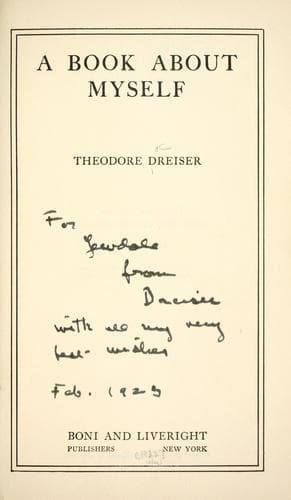
Dreiser, Theodore, 1871-1945; Journalists -- United States -- Biography; Novelists, American -- 20th century -- Biography
The newspaper of largest circulation in this region was the _Blade_ of
Toledo, which he read assiduously. The mother and daughter-in-law did
most of the work. The mother was forever busy cooking breakfast or
dinner, cleaning the rooms, milking, making butter and cheese, gathering
eggs from a nearby hennery. Her large cellar was stocked with jellies,
preserved fruit, apples, potatoes and other vegetables. There was an
ample store of bacon, salt pork and beef. I found that no fresh meat
other than chicken was served, but the meals were delightful and
plentiful, delicious biscuits and jelly, fresh butter, eggs, ham, bacon,
salt pork or cured beef, and the rarely absent fried chicken, as well as
some rabbits which Mich shot. During my stay he did nothing but idle
about the barn, practicing on a cornet which he said had saved his lungs
at a time when he was threatened with consumption. But his playing! I
wonder the cure did not prove fatal. I noted the intense interest of
Mich’s father in what the discovery of gas in this region would do for
it. He was almost certain that all small towns hereabout would now
become prosperous manufacturing centers. There would be work for all.
Wages would go up. Many people would soon come here and become rich.
This of course never came true at all. The flow of natural gas soon gave
out and the oil strikes were not even rivals of some nearby fields.
All this talk was alien to my thoughts. I could not fix my interest on
trade and what it held in store for anybody. I knew it must be so and
that America was destined to grow materially, but somehow the thing did
not interest me. My thoughts leaped to the artistic spectacle such
material prosperity might subsequently present, not to the purely
material phase of the prosperity itself. Indeed I could never think of
the work being done in any factory or institution without passing from
that work to the lives behind it, the crowds of commonplace workers, the
great streets which they filled, the bare homes, and the separate and
distinct dramas of their individual lives. I was tremendously interested
by the rise of various captains of industry then already bestriding
America, their opportunities and pleasures, the ease and skill with
which they organized “trusts” and combinations, their manipulations of
the great railroads, oil and coal fields, their control of the telegraph
and the telephone, their sharp and watchful domination of American
politics; but only as drama. Grover Cleveland was President, and his
every deed was paining the Republicans quite as much as it was
gratifying the Democrats, but I could already see that the lot of the
underdog varied little with the much-heralded changes of
administration—and it was the underdog that always interested me more
than the upper one, his needs, his woes, his simplicities. Here, as
elsewhere, I could see by talking to Mich and his father, men became
vastly excited, paraded and all but wept over the results of one
Public-domain text, read in full here on John Shaqi.
Reviews
Reviews
No reviews yet
Be the first to share your thoughts on this work.
Elsewhere in the archive
Join the Discussion
Join the discussion
Sign in to leave a comment or review.
Sign InorCreate an account