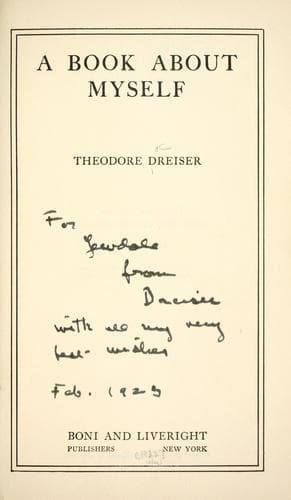
Dreiser, Theodore, 1871-1945; Journalists -- United States -- Biography; Novelists, American -- 20th century -- Biography
And now this national ferment in regard to political preferment and
advancement, the swelling tides of wealth and population in Chicago, the
upward soaring of names and fames, stirred me like whips and goads. I
wanted to get up—oh, how eagerly! I wanted to shake off the garments of
the commonplace in which I seemed swathed and step forth into the public
arena, where I should be seen and understood for what I was. “No common
man am I,” I was constantly saying to myself, and I would no longer be
held down to this shabby world of collecting in which I found myself.
The newspapers—the newspapers—somehow, by their intimacy with everything
that was going on in the world, seemed to be the swiftest approach to
all this of which I was dreaming. It seemed to me as if I understood
already all the processes by which they were made. Reporting, I said to
myself, must certainly be easy. Something happened—one car ran into
another; a man was shot; a fire broke out; the reporter ran to the
scene, observed or inquired the details, got the names and addresses of
those immediately concerned, and then described it all. To reassure
myself on this point I went about looking for accidents on my own
account, or imagining them, and then wrote out what I saw or imagined.
To me the result, compared with what I found in the daily papers, was
quite satisfactory. Some paper must give me a place.
------------------------------------------------------------------------
CHAPTER VII
PICTURE a dreamy cub of twenty-one, long, spindling, a pair of
gold-framed spectacles on his nose, his hair combed _à la pompadour_, a
new spring suit consisting of light check trousers and bright blue coat
and vest, a brown fedora hat, new yellow shoes, starting out to force
his way into the newspaper world of Chicago. At that time, although I
did not know it, Chicago was in the heyday of its newspaper prestige.
Some of the nation’s most remarkable editors, publishers and newspaper
writers were at work there: Melville E. Stone, afterward general manager
of the Associated Press; Victor F. Lawson, publisher of the _Daily
News_; Joseph Medill, editor and publisher of the _Tribune_; Eugene
Field, managing editor of the _Morning Record_; William Penn Nixon,
editor and publisher of the _Inter-Ocean_; George Ade; Finley Peter
Dunne; Brand Whitlock; and a score of others subsequently to become well
known.
Having made up my mind that I must be a newspaper man, I made straight
for the various offices at noon and at six o’clock each day to ask if
there was anything I could do. Very soon I succeeded in making my way
into the presence of the various city and managing editors of all the
papers in Chicago, with the result that they surveyed me with the
cynical fishy eye peculiar to newspaper men and financiers and told me
there was nothing.
Public-domain text, read in full here on John Shaqi.
Reviews
Reviews
No reviews yet
Be the first to share your thoughts on this work.
Join the Discussion
Join the discussion
Sign in to leave a comment or review.
Sign InorCreate an account