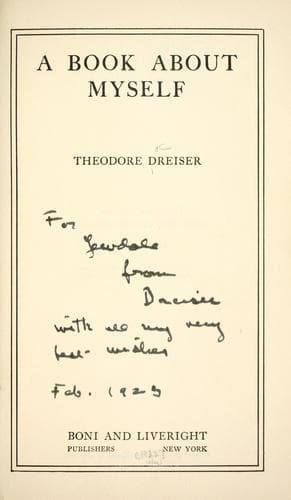
Dreiser, Theodore, 1871-1945; Journalists -- United States -- Biography; Novelists, American -- 20th century -- Biography
I listened with open ears. I caught a disjointed story of plans and
specifications, Sault Ste. Marie, the pine woods of Northern Michigan,
the vast grain business of Chicago and other lake ports, early
navigation on the lakes, the theory of a bilge keel and a turtle-back
top, and all strung together with numerous “y’sees” and “so nows.” I
made notes, on backs of envelopes, scraps of paper, and finally on a pad
furnished me by the generous bookkeeper. I carried my notes back to the
paper.
The Sunday editor was out. I waited patiently until half-past four, and
then, the light fading, gave up the idea of going with a photographer to
the boat. I went to a faded green baize-covered table and began to write
my story. I had no sooner done a paragraph or two than the Sunday editor
returned, bringing with him an atmosphere of lassitude and indifference.
I went to him to explain what I had done.
“Well, write it up, write it up. We’ll see,” and he turned away to his
papers.
I labored hard at my story, and by seven or eight o’clock had ground out
two thousand words of description which had more of the bluff old
captain in it than of the boat. The Sunday editor took it when I was
through, and shoved it into a pigeon-hole, telling me to call in a day
or two and he would let me know. I thought this strange. It seemed to me
that if I were working for a Sunday paper I should work every day. I
called the next day, but Mr. Loomis had not read it. The next day he
said the story was well enough written, though very long. “You don’t
want to write so loosely. Stick to your facts closer.”
This day I suggested a subject of my own, “the beauty of some of the new
suburbs,” but he frowned at this as offering a lot of free advertising
to real estate men who ought to be made to pay. Then I proposed an
article on the magnificence of Euclid Avenue, which was turned down as
old. I then spoke of a great steel works which was but then coming into
the city, but as this offered great opportunity to all the papers he
thought poorly of it. He compromised a day or two later by allowing me
to write up a chicken-farm which lay outside the city.
Of course this made a poor showing for me at the cashier’s desk. At the
end of the second week I was allowed to put in a bill for seven dollars
and a half. I had not realized that I was wasting so much time. I
appealed to all the editors again for a regular staff position, but was
told there was no opening. It began to look as if I should have to leave
Cleveland soon, and I wondered where I should go next—Buffalo or
Pittsburgh, both equally near.
------------------------------------------------------------------------
CHAPTER LVIII
Public-domain text, read in full here on John Shaqi.
Reviews
Reviews
No reviews yet
Be the first to share your thoughts on this work.
Elsewhere in the archive
Join the Discussion
Join the discussion
Sign in to leave a comment or review.
Sign InorCreate an account