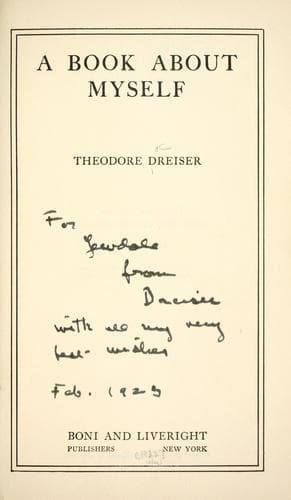
Dreiser, Theodore, 1871-1945; Journalists -- United States -- Biography; Novelists, American -- 20th century -- Biography
FINDING Cleveland hopeless for me, I one day picked up and left. Then
came Buffalo, which I reached toward the end of March. Aside from the
Falls I found it a little tame, no especial snap to it—not as much as I
had felt to be characteristic of Cleveland. What interest there was for
me I provided myself, wandering about in odd drear neighborhoods, about
grain elevators and soap factories and railroad yards and manufacturing
districts. Here, as in Cleveland, I could not help but see that in spite
of our boasted democracy and equality of opportunity there was as much
misery and squalor and as little decent balancing of opportunity against
energy as anywhere else in the world. The little homes, the poor,
shabby, colorless, drear, drab little homes with their grassless
“yards,” their unpaved streets, their uncollected garbage, their
fluttering, thin-flamed gas-lamps, the crowds of ragged, dirty,
ill-cared-for children! Near at hand was always the inevitable and
wretched saloon, not satisfying a need for pleasure in a decent way but
pandering to the lowest and most conniving and most destroying instincts
of the lowest politicians and heelers and grafters and crooks, while the
huge financial and manufacturing magnates at the top with their lust for
power and authority used the very flesh of the weaker elements for
purposes of their own. It was the saloon, not liquor, which brought
about the prohibition folly. I used to listen, as a part of my
reportorial duties, to the blatherings of thin-minded, thin-blooded,
thin-experienced religionists as well as to those of kept editorial
writers, about the merits and blessings and opportunities of our noble
and bounteous land; but whenever I encountered such regions as this I
knew well enough that there was something wrong with their noble
maunderings. Shout as they might, there was here displayed before my
very eyes ample evidence that somewhere there was a screw loose in the
“Fatherhood of Man—Brotherhood of God” machinery.
After I had placed myself in a commonplace neighborhood near the
business center, I canvassed the newspaper offices and their editors.
Although I had in my pocket that letter from the publisher of the St.
Louis _Republic_ extolling my virtues as a reporter and correspondent,
so truly vagrom was my mood and practical judgment that I did not
present it to any one. Instead I merely mooned into one office after
another (there were only four papers here), convinced before entering
that I should not get anything—and I did not. One young city editor,
seeming to take at least an interest in me, assured me that if I would
remain in Buffalo for six weeks he could place me; but since I had not
enough money to sustain myself so long I decided not to wait. Ten days
spent in reconnoitering these offices daily, and I concluded that it was
useless to remain longer. Yet before I went I determined to see at least
one thing more: the Falls.
Public-domain text, read in full here on John Shaqi.
Reviews
Reviews
No reviews yet
Be the first to share your thoughts on this work.
Elsewhere in the archive
Join the Discussion
Join the discussion
Sign in to leave a comment or review.
Sign InorCreate an account