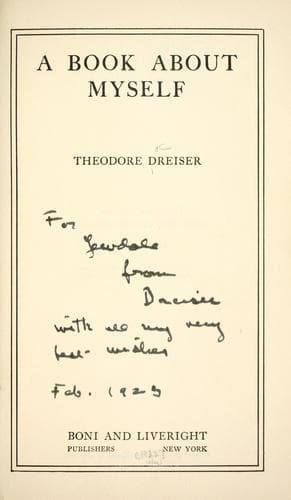
Dreiser, Theodore, 1871-1945; Journalists -- United States -- Biography; Novelists, American -- 20th century -- Biography
I came down to it through the brown-blue mountains of Western
Pennsylvania, and all day long we had been winding at the base of one or
another of them, following the bed of a stream or turning out into a
broad smooth valley, crossing directly at the center of it, or climbing
some low ridge with a puff-puff-puff and then clattering almost
recklessly down the other slope. I had never before seen any mountains.
The sight of sooty-faced miners at certain places, their little oil and
tow tin lamps fastened to their hats, their tin dinner-pails on their
arms, impressed me as something new and faintly reminiscent of the one
or two small coal mines about Sullivan, Indiana, where I had lived when
I was a boy of seven. Along the way I saw a heavy-faced and heavy-bodied
type of peasant woman, with a black or brown or blue or green skirt and
a waist of a contrasting color, a headcloth or neckerchief of still
another, trailed by a few children of equally solid proportions, hanging
up clothes or doing something else about their miserable places. These
were the much-maligned hunkies just then being imported by the large
manufacturing and mining and steel-making industries of the country to
take the place of the restless and less docile American working man and
woman. I marveled at their appearance and number, and assumed,
American-fashion, that in their far-off and unhappy lands they had heard
of the wonderful American Constitution, its guaranty of life, liberty
and the pursuit of happiness, as well as of the bounteous opportunities
afforded by this great land, and that they had forsaken their miseries
to come all this distance to enjoy these greater blessings.
I did not then know of the manufacturers’ foreign labor agent with his
lying propaganda among ignorant and often fairly contented peasants,
painting America as a country rolling in wealth and opportunity, and
then bringing them here to take the places of more restless and greatly
underpaid foreigners who, having been brought over by the same gay
pictures, were becoming irritated and demanded more pay. I did not then
know of the padrone, the labor spy, the company store, five cents an
hour for breaker children, the company stockade, all in full operation
at this time. All I knew was that there had been a great steel strike in
Pittsburgh recently, that Andrew Carnegie, as well as other steel
manufacturers (the Olivers, for one), had built fences and strung them
with electrified barbed wire in order to protect themselves against the
“lawless” attacks of “lawless” workingmen.
Public-domain text, read in full here on John Shaqi.
Reviews
Reviews
No reviews yet
Be the first to share your thoughts on this work.
Elsewhere in the archive
Join the Discussion
Join the discussion
Sign in to leave a comment or review.
Sign InorCreate an account