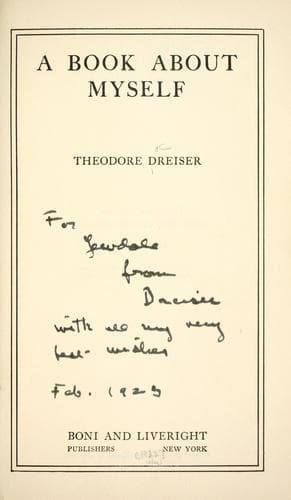
Dreiser, Theodore, 1871-1945; Journalists -- United States -- Biography; Novelists, American -- 20th century -- Biography
I also knew that a large number of State or county or city paid deputy
sheriffs and mounted police and city policemen had been sworn in and set
to guarding the company’s property and that H. C. Frick, a leading steel
manager for Mr. Carnegie, had been slightly wounded by a desperado named
Alexander Berkman, who was inflaming these workingmen, all foreigners of
course, lawless and unappreciative of the great and prosperous steel
company which was paying them reasonable wages and against which they
had no honest complaint.
Our mid-Western papers, up to the day of Cleveland’s election in 1892
and for some time after, had been full of the merits of this labor
dispute, with long and didactic editorials, intended in the main to
prove that the workingman was not so greatly underpaid, considering the
type of labor he performed and the intelligence he brought to his task;
that the public was not in the main vastly interested in labor disputes,
both parties to the dispute being unduly selfish; that it would be a
severe blow to the prosperity of the country if labor disputes were too
long continued; that unless labor was reasonable in its demands capital
would become disheartened and leave the country. I had not made up my
mind that the argument was all on one side, although I knew that the
average man in America, despite its great and boundless opportunities,
was about as much put upon and kicked about and underpaid as any other.
This growing labor problem or the general American dissatisfaction with
poor returns upon efforts made crystallized three years later in the
Free Silver campaign and the “gold parades.” The “full dinner-pail” was
then invented as a slogan to counteract the vast economic unrest, and
the threat to close down and so bring misery to the entire country
unless William McKinley was elected was also freely posted. Henry
George, Father McGlynn, Herr Most, Emma Goldman, and a score of others
were abroad voicing the woes of hundreds of thousands who were supposed
to have no woes.
Public-domain text, read in full here on John Shaqi.
Reviews
Reviews
No reviews yet
Be the first to share your thoughts on this work.
Elsewhere in the archive
Join the Discussion
Join the discussion
Sign in to leave a comment or review.
Sign InorCreate an account