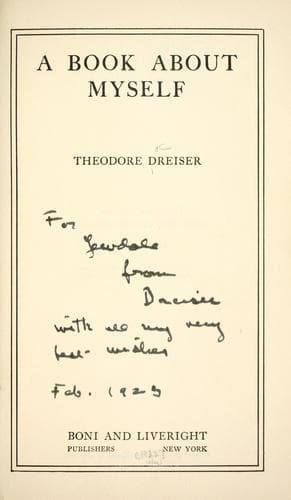
Dreiser, Theodore, 1871-1945; Journalists -- United States -- Biography; Novelists, American -- 20th century -- Biography
In a very little while I came to be on friendly terms with the men of
this and some other papers, men who, because of their intimate contact
with local political and social conditions, were well fitted to
enlighten me as to the exact economic and political conditions here. Two
in particular, the political and labor men of this paper were most
helpful. The former, a large, genial, commercial-drummer type, who might
also have made an excellent theatrical manager or promoter, provided me
with a clear insight into the general cleavage of local and State
politics and personalities. I liked him very much. The other, the labor
man, was a slow, silent, dark, square-shouldered and almost
square-headed youth, who drifted in and out of the office irregularly.
He it was who attended, when permitted by the working people themselves,
all labor meetings in the city or elsewhere, as far east at times as the
hard coal regions about Wilkes-Barre and Scranton. As he himself told
me, he was the paper’s sole authority for such comments or assertions as
it dared to make in connection with the mining of coal and the
manufacture of steel. He was an intense sympathizer with labor, but not
so much with organized as with unorganized workers. He believed that
labor here had two years before lost a most important battle, one which
would show in its contests with money in the future: which was true. He
pretended to know that there was a vast movement on foot among the
moneyed elements in America to cripple if not utterly destroy organized
labor, and to that end he assured me once that all the great steel and
coal and oil magnates were in a conspiracy to flood the country with
cheap foreign labor, which they had lured or were luring here by all
sorts of dishonest devices; once here, these immigrants were to be used
to break the demand of better-paid and more intelligent labor. He
pretended to know that in the coal and steel regions thousands had
already been introduced and more were on their way, and that all such
devices as showy churches and schools for defectives, etc., were used to
keep ignorant and tame those already here.
“But you can’t say anything about it in Pittsburgh,” he said to me. “If
I should talk I’d have to get out of here. The papers here won’t use a
thing unfavorable to the magnates in any of these fields. I write all
sorts of things, but they never get in.”
Public-domain text, read in full here on John Shaqi.
Reviews
Reviews
No reviews yet
Be the first to share your thoughts on this work.
Elsewhere in the archive
Join the Discussion
Join the discussion
Sign in to leave a comment or review.
Sign InorCreate an account