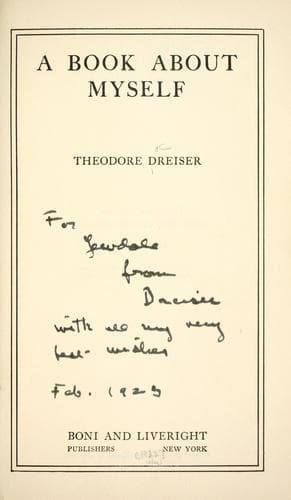
Dreiser, Theodore, 1871-1945; Journalists -- United States -- Biography; Novelists, American -- 20th century -- Biography
He read the _Congressional Record_ daily, as well as various radical
papers from different parts of the country, and was constantly calling
my attention to statistics and incidents which proved that the
workingman was being most unjustly put upon and undermined; but he never
did it in any urgent or disturbed manner. Rather, he seemed to be
profoundly convinced that the cause of the workers everywhere in America
was hopeless. They hadn’t the subtlety and the force and the innate
cruelty of those who ruled them. They were given to religious and
educational illusions, the parochial school and church paper, which left
them helpless. In the course of time, because I expressed interest in
and sympathy for these people, he took me into various mill slums in and
near the city to see how they lived.
------------------------------------------------------------------------
CHAPTER LXI
I WENT with him first to Homestead, then to some tenements there, later
to some other mill districts nearer Pittsburgh, the name of which I have
forgotten. What astonished me, in so far as the steel mills were
concerned, was the large number of furnaces going at once, the piles,
mountains, of powdered iron ore ready to be smelted, the long lines of
cars, flat, box and coal cars, and the nature and size and force of the
machinery used to roll steel. The work, as he or his friends the bosses
showed me, was divided between the “front” and the “back.” Those working
at the front of the furnace took care of the molten ore and slag which
was being “puddled.” The men at the back, the stock and yard men, filled
huge steel buckets or “skips” suspended from traveling cranes with ore,
fuel and limestone, all of which was piled near at hand; this material
was then trundled to a point over the mouth of the melting-vats, as they
were called, and “released” via a movable bottom. At this particular
plant I was told that the machinery for handling all this was better
than elsewhere, the company being richer and more progressive. In some
of the less progressive concerns the men filled carts with raw material
and then trundled them around to the front of a hoist, which was at the
back of the furnace, where they were lifted and dumped into the
furnaces. But in this mill all a man had to do to fill a steel bucket
with raw material was to push one of those steel buckets suspended from
a trolley under a chute and pull a rod, when the “stock” tumbled into
it. From these it was trundled, by machinery, to a point over the
furnace. The furnaces were charged or fed constantly by feeders working
in twelve-hour shifts, so that there was little chance to rest from
their labors. Their pay was not more than half of that paid to the men
at the “front” because it was neither so hard nor so skillful, although
it looked hard enough to me.
Public-domain text, read in full here on John Shaqi.
Reviews
Reviews
No reviews yet
Be the first to share your thoughts on this work.
Elsewhere in the archive
Join the Discussion
Join the discussion
Sign in to leave a comment or review.
Sign InorCreate an account