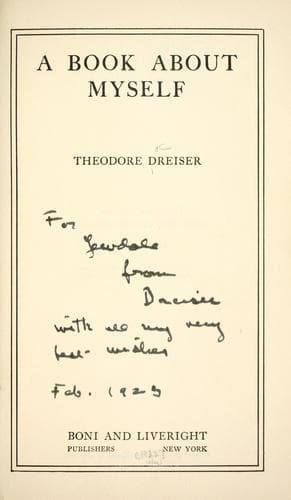
Dreiser, Theodore, 1871-1945; Journalists -- United States -- Biography; Novelists, American -- 20th century -- Biography
My friend Martyn, who was intensely sympathetic toward them, was still
more sympathetic toward the men who were not so skillful, mere day
laborers who received from one dollar to one-sixty-five at a time when
two a day was too little to support any one. He grew melodramatic as he
told me where these men lived and how they lived, and finally took me in
order that I might see for myself. Afterward, in the course of my
reportorial work, I came upon some of these neighborhoods and
individuals, and since they are all a part of the great fortune-building
era, and illustrate how democracy works in America, and how some great
fortunes were built, I propose to put down here a few pictures of things
that I saw. Wages varied from one to one-sixty-five a day for the
commonest laborer, three and even four a day for the skilled worker.
Rents, or what the cheaper workers, who constituted by far the greater
number, were able to pay, varied from two-fifteen per week, or
eight-sixty per month, to four-seventy-two per week, or twenty per
month.
And the type of places they could secure for this! I recall visiting a
two-room tenement in a court, the character of which first opened my
eyes to the type of home these workers endured. This court consisted of
four sides with an open space in the center. Three of these sides were
smoke-grimed wooden houses three stories in height; the fourth was an
ancient and odorous wooden stable, where the horses of a contractor were
kept. In the center of this court stood a circular wooden building or
lavatory with ten triangular compartments, each opening into one vault
or cesspool. Near this was one hydrant, the only water-supply for all
these homes or rooms. These two conveniences served twenty families,
Polish, Hungarian, Slavonic, Jewish, Negro, of from three to five people
each, living in the sixty-three rooms which made up the three grimy
sides above mentioned. There were twenty-seven children in these rooms,
for whom this court was their only playground. For twenty housewives
this was the only place where they could string their wash-lines. For
twenty tired, sweaty, unwashed husbands this was, aside from the saloon,
the only near and neighborly recreation and companionship center. Here
of a sweltering summer night, after playing cards and drinking beer,
they would frequently stretch themselves to sleep.
Public-domain text, read in full here on John Shaqi.
Reviews
Reviews
No reviews yet
Be the first to share your thoughts on this work.
Elsewhere in the archive
Join the Discussion
Join the discussion
Sign in to leave a comment or review.
Sign InorCreate an account