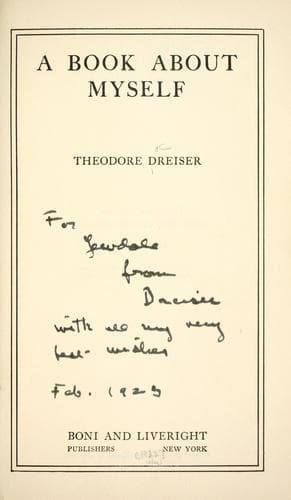
Dreiser, Theodore, 1871-1945; Journalists -- United States -- Biography; Novelists, American -- 20th century -- Biography
But the men who most fascinated me were the “roughers” who, once the
puddler had done his work and thrown his lump of red-hot iron out upon
an open hearth, and another man had taken it and thrown it to a
“rougher,” fed it into a second machine which rolled or beat it into a
more easily handled and workable form. The exact details of the process
escape me now, but I remember the picture they presented in those hot,
fire-lighted, noisy and sputtering rooms. Agility and even youth were at
a premium, and a false step possibly meant death. I remember watching
two men in the mill below Mt. Washington, one who pulled out billet
after billet from furnace after furnace and threw them along the steel
floor to the “rougher,” and the latter, who, dressed only in trousers
and a sleeveless flannel shirt, the sweat pouring from his body and his
muscles standing out in knots, took these same and, with the skill and
agility of a tight-rope performer, tossed them into the machine. He was
constantly leaping about thrusting the red billets which came almost in
a stream into or between the first pair of rolls for which they were
intended. And yet before he could turn back there was always another on
the floor behind him. The rolls into which he fed these billets were
built in a train, side by side in line, and as they went through one
pair they had to be seized by a “catcher” and shoved back through the
next. Back and forth, back and forth they went at an ever increasing
speed, until the catcher at the next to the last pair of rolls, seizing
the end of the rod as it came through, still red-hot, described with it
a fiery circle bending it back again to enter the last roll, from which
it passed into water. It was wonderful.
And yet these men were not looked upon as anything extraordinary. While
the places in which they worked were metal infernos and their toil of
the most intense and exacting character, they were not allowed to
organize to better their condition. The recent great victory of the
steel magnates had settled that. In that very city and elsewhere, these
magnates were rolling in wealth. Their profits were tumbling in so fast
that they scarcely knew what to do with them. Vast libraries and
universities were being built with their gifts. Immense mansions were
crowded with art and historic furniture. Their children were being sent
to special schools to be taught how to be ladies and gentlemen in a
democracy which they contemned; and on the other hand, these sweating
men were being denied an additional five or ten cents an hour and the
right to organize. If they protested or attempted to drive out imported
strike-breakers they were fired and State or Federal troops were called
in to protect the mills. They could not organize then, and they are not
organized now.
Public-domain text, read in full here on John Shaqi.
Reviews
Reviews
No reviews yet
Be the first to share your thoughts on this work.
Elsewhere in the archive
Join the Discussion
Join the discussion
Sign in to leave a comment or review.
Sign InorCreate an account