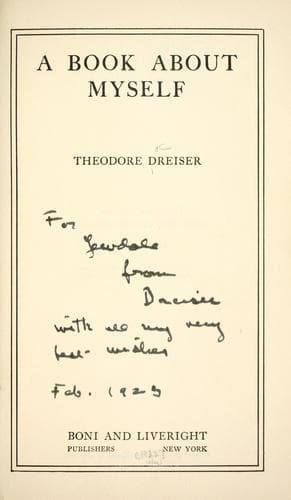
Dreiser, Theodore, 1871-1945; Journalists -- United States -- Biography; Novelists, American -- 20th century -- Biography
“Just looking for work?”
“Yes.”
“Ever work on any paper?”
“No.”
“How do you know you can write?”
“I don’t. I just feel that I can. I want to see if I can’t get a chance
to try.”
He looked at me, curiously, amusedly, cynically.
“Don’t you ever go around to the other papers?”
“Yes, after I find out there’s nothing here.”
He smiled. “How long have you been coming here like this?”
“Two weeks.”
“Every day?”
“Every day.”
He laughed now, a genial, rolling, fat laugh.
“Why do you pick the _Globe_? Don’t you know it’s the poorest paper in
Chicago?”
“That’s why I pick it,” I replied innocently. “I thought I might get a
chance here.”
“Oh, you did!” he laughed. “Well, you may be right at that. Hang around.
You may get something. Now I’ll tell you something: this National
Democratic Convention will open in June. They’ll have to take on a few
new men here then. I can’t see why they shouldn’t give you a chance as
well as anybody else. But it’s a hell of a business to be wanting to get
into,” he added.
He began taking off his coat and waistcoat, rolling up his sleeves,
sharpening his blue pencils and taking up stacks of copy. The while I
merely stared at him. Every now and then he would look at me through his
round glasses as though I were some strange animal. I grew restless and
went out. But after that he greeted me each day in a friendly way, and
because he seemed inclined to talk I stayed and talked with him.
What it was that finally drew us together in a minor bond of friendship
I have never been able to discover. I am sure he considered me of little
intellectual or reportorial import and yet also I gathered that he liked
me a little. He seemed to take a fancy to me from the moment of our
first conversation and included me in what I might call the _Globe_
family spirit. He was interested in politics, literature, and the
newspaper life of Chicago. Bit by bit he informed me as to the various
editors, who were the most successful newspaper men, how some reporters
did police, some politics, and some just general news. From him I
learned that every paper carried a sporting editor, a society editor, a
dramatic editor, a political man. There were managing editors, Sunday
editors, news editors, city editors, copy-readers and editorial writers,
all of whom seemed to me marvelous—men of the very greatest import. And
they earned—which was more amazing still—salaries ranging from eighteen
to thirty-five and even sixty and seventy dollars a week. From him I
learned that this newspaper world was a seething maelstrom in which
clever men struggled and fought as elsewhere; that some rose and many
fell; that there was a roving element among newspaper men that drifted
from city to city, many drinking themselves out of countenance, others
settling down somewhere into some fortunate berth. Before long he told
me that only recently he had been copy-reader on the Chicago _Times_ but
due to what he characterized as “office politics,” a term the meaning of
Public-domain text, read in full here on John Shaqi.
Reviews
Reviews
No reviews yet
Be the first to share your thoughts on this work.
Join the Discussion
Join the discussion
Sign in to leave a comment or review.
Sign InorCreate an account