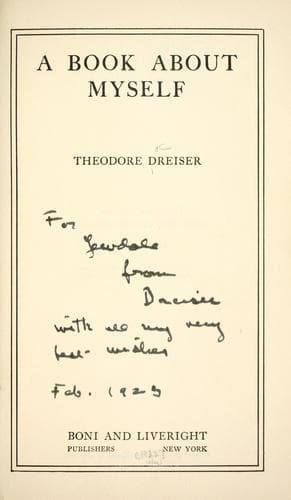
Dreiser, Theodore, 1871-1945; Journalists -- United States -- Biography; Novelists, American -- 20th century -- Biography
Another exclaimed: “Harry Gissel! Has that little snip written a book?
The nerve—to send you around to sell his book! Why do you do it? I will
take one, because I am curious to see the kind of thing he has done, but
I’ll wager right now it’s as silly as he is. He’s invented some scheme
to get you to do this because he knows he couldn’t sell the book in any
other way.”
Others remembered him and seemed to like him; others bought the book
only because he was a member of their class. Some struck up a genial
conversation with me.
In spite of my distress at having to do this work there were
compensations. It gave me a last fleeting picture of that new, sunny
prosperity which was the most marked characteristic of Chicagoans of
that day, and contrasted so sharply with the scenes of poverty which I
had recently seen. In this region, for it was June, newly fledged
collegians, freshly returned from the colleges of the East and Europe,
were disporting themselves about the lawns and within the open-windowed
chambers of the houses. Traps and go-carts of many of the financially
and socially elect filled the south side streets. The lawn tennis suit,
the tennis game, the lawn party and the family croquet game were
everywhere in evidence. The new-rich and those most ambitious
financially at that time were peculiarly susceptible I think to the airs
and manners of the older and more pretentious regions of the world. They
were bent upon interpreting their new wealth in terms of luxury as they
had observed it elsewhere. Hence these strutting youths in English suits
with turned-up trousers, swagger sticks and flori-colored ties and socks
intended to suggest the spirit of London, as they imagined it to be;
hence the high-headed girls in flouncy, lacy dresses, their cheeks and
eyes bright with color, who no doubt imagined themselves to be great
ladies, and who carried themselves with an air of remote disdain. The
whole thing had the quality of a play well staged: really the houses,
the lawns, the movements of the people, their games and interests all
harmonizing after the fashion of a play. They saw this as a great end in
itself, which, perhaps, it is. To me in my life-hungry, love-hungry
state, this new-rich prosperity with its ease, its pretty women and its
effort at refinement was quite too much. It set me to riotous dreaming
and longing made me ache to lounge and pose after this same fashion.
------------------------------------------------------------------------
CHAPTER IX
Public-domain text, read in full here on John Shaqi.
Reviews
Reviews
No reviews yet
Be the first to share your thoughts on this work.
Join the Discussion
Join the discussion
Sign in to leave a comment or review.
Sign InorCreate an account