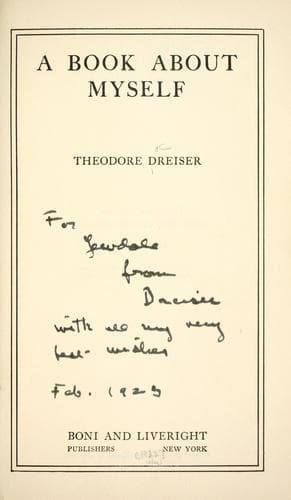
Dreiser, Theodore, 1871-1945; Journalists -- United States -- Biography; Novelists, American -- 20th century -- Biography
“No, no, no!” he exclaimed. “You mustn’t write on both sides of the
paper! Don’t you know that? For heaven’s sake. And all this stuff about
the political pot boiling is as old as the hills. Why, every country
jake paper for thousands of miles East and West has used it for years
and years. You’re not to write the general stuff. Here, Maxwell, see if
you can’t find out what Dreiser has discovered and show him what to do
with it. I haven’t got time.” And he turned me over to my
gold-spectacled mentor, who eyed me very severely. He sat down and
examined my copy with knitted brows. He had a round, meaty, cherubic
face which seemed all the more ominous because he could scowl fiercely,
and his eyes could blaze with a cold, examining, mandatory glance.
“This is awful stuff!” he said as he read the first page. “He’s quite
right. You want to try and remember that you’re not the editor of this
paper and just consider yourself a plain reporter sent out to cover some
hotels. Now where’d you go today?”
I told him.
“What’d you see?”
I described as best I could the whirling world in which I had been.
“No, no! I don’t mean that! That might be good for a book or something
but it’s not news. Did you see any particular man? Did you find out
anything in connection with any particular committee?”
I confessed that I had tried and failed.
“Very good!” he said. “You haven’t anything to write,” and he tore up my
precious nine pages and threw them into the waste basket. “You’d better
sit around here now until the city editor calls you,” he added. “He may
have something special he wants you to do. If not, watch the hotels for
celebrities—Democratic celebrities—or committee meetings, and if you
find any try to find out what’s going on. The great thing is to discover
beforehand who’s going to be nominated—see? You can’t tell from talking
to four or five people, but what you find out may help some one else to
piece out what is to happen. When you come back, see me. And unless you
get other orders, come back by eleven. And call up two or three times
between the time you go and eleven.”
Because of these specific instructions I felt somewhat encouraged,
although my first attempt at writing had been thrown into the waste
basket. I sat about until nearly seven, when I was given an address and
told to find John G. Carlisle, ex-Secretary of the Treasury, and see if
I could get an interview with him. Failing this, I was to “cover” the
Grand Pacific, Palmer House and Auditorium, and report all important
arrivals and delegations.
Even if I had secured the desired interview I am sure I should have made
an awful botch of it, but fortunately I could not get it. Only one thing
of importance developed for me during the evening, and that was the
presence of a Democratic United States Supreme Court Justice at the
Grand Pacific who, upon being intercepted by me as he was going to his
room for the night and told that I was from the _Globe_, eyed me
genially and whimsically.
Public-domain text, read in full here on John Shaqi.
Reviews
Reviews
No reviews yet
Be the first to share your thoughts on this work.
Join the Discussion
Join the discussion
Sign in to leave a comment or review.
Sign InorCreate an account