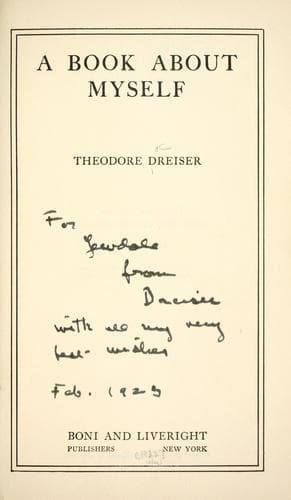
Dreiser, Theodore, 1871-1945; Journalists -- United States -- Biography; Novelists, American -- 20th century -- Biography
He bustled out to a shady balcony overlooking the lake, ordered two
cocktails and wanted to know on what I based my calculation. In order to
not seem a fool I now went over my conversation with Maxwell. I spoke of
different delegations and their complexions as though these conclusions
were my own, when as a matter of fact I was quoting Maxwell verbatim. My
hearer seemed surprised at my intelligence.
“You seem to be very well informed,” he said genially, “but I know
you’re wrong. The Democratic party will never go to the South for a
candidate—not for some years anyway. Just the same, since you’ve been
good enough to champion me in this public fashion, I would like to do
something for you in return. I suppose your paper is always anxious for
advance news, and if you bring it in you get the credit. Now at this
very moment, over in the Hotel Richelieu, Mr. William C. Whitney and
some of his friends—Mr. Croker has just gone over there—are holding a
conference. He is the one man who holds the balance of power in this
convention. He represents the moneyed interests and is heart and soul
for Grover Cleveland. Now if you want a real beat you’d better go over
there and hang about. Mr. Whitney is sure to make a statement some time
today or tomorrow. See his secretary, Mr. ——, and tell him I sent you.
He will do anything for you he can.”
I thanked him, certain at last I had a real piece of news. This
conference was the most important event that would or could take place
in the whole convention. I was so excited that I wanted to jump up and
run away.
“It will keep,” he said, noting my nervousness. “No other newspaper man
knows of it yet. Nothing will be given out yet for several hours because
the conference will not be over before that time.”
“But I’d like to phone my office,” I pleaded.
“All right, but come back.”
I ran to the nearest telephone. I explained my beat to the city editor
and, anxious lest I be unable to cover it, asked him to inform the head
political man. He was all excitement at once, congratulated me and told
me to follow up this conference. Then I ran back to my senator.
“I see,” he said, “that you are a very industrious and eager young man.
I like to see that. I don’t want to say anything which will set up your
hopes too much, because things don’t always work out as one would wish,
but did any one ever suggest to you that you would make a good private
secretary?”
“No, sir,” I replied, flattered and eager.
“Well, from what I have seen here today I am inclined to think you
would. Now I don’t know that I shall be returned to the Senate after
this year—there’s a little dispute in my State—but if I am, and you want
to write me after next January, I may be able to do something for you.
I’ve seen a lot of bright young fellows come up in the newspaper
profession, and I’ve seen a lot go down. If you’re not too much attached
to it, perhaps you would like this other better.”
Public-domain text, read in full here on John Shaqi.
Reviews
Reviews
No reviews yet
Be the first to share your thoughts on this work.
Join the Discussion
Join the discussion
Sign in to leave a comment or review.
Sign InorCreate an account