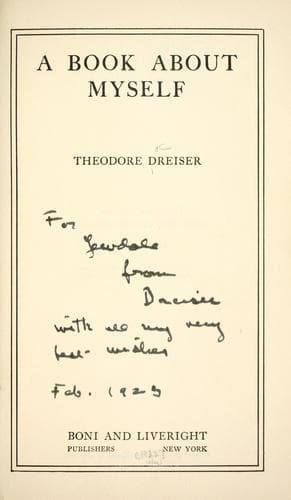
Dreiser, Theodore, 1871-1945; Journalists -- United States -- Biography; Novelists, American -- 20th century -- Biography
THIS world of newspaper men who now received me on terms of social
equality, who saw life from a purely opportunistic, and yet in the main
sentimentally imaginative, viewpoint broadened me considerably and
finally liberated me from moralistic and religionistic qualms. So many
of them were hard, gallant adventurers without the slightest trace of
the nervousness and terror of fortune which agitated me. They had been
here, there, everywhere—San Francisco, Los Angeles, New York, Calcutta,
London. They knew the ways of the newspaper world and to a limited
extent the workings of society at large. The conventional-minded would
have called them harsh, impracticable, impossible, largely because they
knew nothing of trade, that great American standard of ability and
force. Most of them, as I soon found, were like John Maxwell, free from
notions as to how people were to act and what they were to think. To a
certain extent they were confused by the general American passive
acceptance of the Sermon on the Mount and the Beatitudes as governing
principles, but in the main they were nearly all mistrustful of these
things, and of conventional principles in general.
They did not believe, as I still did, that there was a fixed moral order
in the world which one contravened at his peril. Heaven only knows where
they had been or what they had seen, but they misdoubted the motives,
professed or secret, of nearly every man. No man, apparently, was
utterly and consistently honest, that is, no man in a powerful or
dominant position; and but few were kind or generous or truly
public-spirited. As I sat in the office between assignments, or
foregathered with them at dinner or at midnight in some one of the many
small restaurants frequented by newspaper men, I heard tales of all
sorts of scandals: robberies, murders, fornications, incendiarisms, not
only in low life but in our so-called high life. Most of these young men
looked upon life as a fierce, grim struggle in which no quarter was
either given or taken, and in which all men laid traps, lied,
squandered, erred through illusion: a conclusion with which I now most
heartily agree. The one thing I would now add is that the brigandage of
the world is in the main genial and that in our hour of success we are
all inclined to be more or less liberal and warm-hearted.
But at this time I was still sniffing about the Sermon on the Mount and
the Beatitudes, expecting ordinary human flesh and blood to do and be
those things. Hence the point of view of these men seemed at times a
little horrific, at other times most tonic.
“People make laws for other people to live up to,” Maxwell once said to
me, “and in order to protect themselves in what they have. They never
intend those laws to apply to themselves or to prevent them from doing
anything they wish to do.”
Public-domain text, read in full here on John Shaqi.
Reviews
Reviews
No reviews yet
Be the first to share your thoughts on this work.
Join the Discussion
Join the discussion
Sign in to leave a comment or review.
Sign InorCreate an account