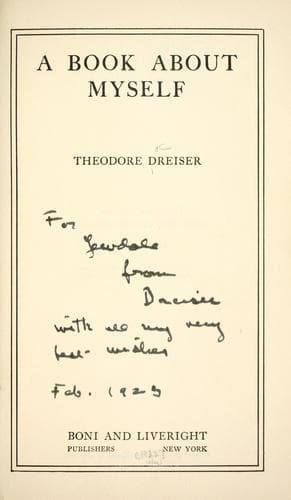
Dreiser, Theodore, 1871-1945; Journalists -- United States -- Biography; Novelists, American -- 20th century -- Biography
The first afternoon I saw him sitting in the city editorial chair I was
very much afraid of him and of my future. He looked raucous and uncouth,
and Maxwell had told me that new editors usually brought in new men. As
it turned out, however, much to my astonishment, he took an almost
immediate fancy to me which ripened into a kind of fatherly affection
and even, if you will permit me humbly to state a fact, a kind of
adoration. Indeed he swelled my head by the genial and hearty manner in
which almost at once he took me under his guidance and furthered my
career as rapidly as he could, the while he borrowed as much of my small
salary as he could. Please do not think that I begrudged this then or
that I do now. I owe him more than a dozen such salaries borrowed over a
period of years could ever repay. My one grief is, that I had so little
to give him in return for the very great deal he did for me.
The incident from which this burst of friendship seemed to take its rise
was this. One day shortly after he arrived he gave me a small clipping
concerning a girl on the south side who had run away or had been
kidnaped from one of the dreariest homes it has ever been my lot to see.
The girl was a hardy Irish creature of about sixteen. A neighborhood
street boy had taken her to some wretched dive in South Clark Street and
seduced her. Her mother, an old, Irish Catholic woman whom I found
bending over a washtub when I called, was greatly exercised as to what
had become of her daughter, of whom she had heard nothing since her
disappearance. The police had been informed, and from clews picked up by
a detective I learned the facts first mentioned. The mother wept into
her wash as she told me of the death of her husband a few years before,
of a boy who had been injured in such a way that he could not work, and
now this girl, her last hope——
From a newspaper point of view there was nothing much to the story, but
I decided to follow it to the end. I found the house to which the boy
had taken the girl, but they had just left. I found the parents of the
youth, simple, plain working people, who knew nothing of his
whereabouts. Something about the wretched little homes of both families,
the tumbledown neighborhoods, the poverty and privation which would ill
become a pretty sensuous girl, impelled me to write it out as I saw and
felt it. I hurried back to the office that afternoon and scribbled out a
kind of slum romance, which in the course of the night seemed to take
the office by storm. Maxwell, who read it, scowled at first, then said
it was interesting, and then fine.
“Carl,” he interpolated at one point as he read, “you’re letting your
youthful romantic mood get the best of you, I see. This will never do,
Carl. Read Schopenhauer, my boy, read Schopenhauer.”
Public-domain text, read in full here on John Shaqi.
Reviews
Reviews
No reviews yet
Be the first to share your thoughts on this work.
Join the Discussion
Join the discussion
Sign in to leave a comment or review.
Sign InorCreate an account