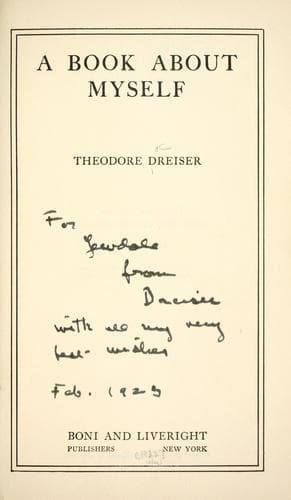
Dreiser, Theodore, 1871-1945; Journalists -- United States -- Biography; Novelists, American -- 20th century -- Biography
I first saw him at a political meeting during my first few weeks in St.
Louis, and the manner in which he arose, the way in which he addressed
his hearers, the way in which they listened to him, all impressed me.
Subsequently, being sent to his house, I found him in his small front
parlor, a yellow plush album on the marble-topped center table,
horse-hair furniture about the room, a red carpet, crayon enlargements
of photographs of his mother and father. But what force in the man! What
innate gentility of manner and speech! He seemed like a prince disguised
as a blacksmith.
“So ye’ve come to interview me,” he said soothingly. “Ye’re from the
_Globe-Democrat_—well, that paper’s no particular friend of mine, but ye
can’t help that, can ye?” and then he told me whatever it was I wanted
to know, giving me no least true light, you may be sure. At the
conclusion he offered me a drink, which I refused. As I was about to
leave he surveyed me pleasantly and tolerantly.
“Ye’re a likely lad,” he said, laying an immense hand on one of my lean
shoulders, “and ye’re jest startin’ out in life, I can see that. Well,
be a good boy. Ye’re in the newspaper business, where ye can make
friends or enemies just as ye choose, and if ye behave yerself right ye
can just as well make friends. Come an’ see me some time. I like yer
looks. I’m always here av an evenin’, when I’m not attendin’ a meetin’
av some kind, right here in this little front room, or in the kitchen
with me wife. I might be able to do something fer ye sometime—remember
that. I’ve a good dale av influence here. Ye’ll have to write what ye’re
told, I know that, so I won’t be offended. So come an’ see me, an’
remember that I want nothin’ av ye,” and he gently ushered me out and
closed the door behind me.
But I never went, at least not for anything for myself. The one time I
asked him for a position for a friend who wanted to work on the local
street-cars as a conductor he wrote across the letter: “Give this man
what he wants.” It was wretchedly scrawled (the man brought it back to
me before presenting it) and was signed “edward butler.” But the man was
given the place at once.
Although Butler was an earnest Catholic, he was supposed to control and
tax the vice of the city; which charge may or may not have been true.
One of his sons owned and managed the leading vaudeville house in the
city, a vulgar burlesque theater, at which the ticket taker was Frank
James, brother of the amazing Jesse who terrorized Missouri and the
Southwest as an outlaw at one time and enriched endless dime novel
publishers afterward. As dramatic critic of the _Globe-Democrat_ later I
often saw him. Butler’s son, a more or less stodgy type of Tammany
politician, popular with a certain element in St. Louis, was later
elected to Congress.
Public-domain text, read in full here on John Shaqi.
Reviews
Reviews
No reviews yet
Be the first to share your thoughts on this work.
Elsewhere in the archive
Join the Discussion
Join the discussion
Sign in to leave a comment or review.
Sign InorCreate an account