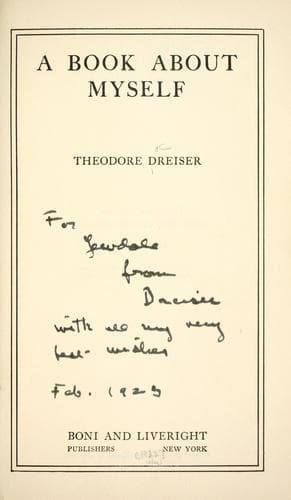
Dreiser, Theodore, 1871-1945; Journalists -- United States -- Biography; Novelists, American -- 20th century -- Biography
I wrote up a labor meeting or two, and at one of these saw for the first
time Terence V. Powderly, the head of the dominant labor
organization—the Knights of Labor. This meeting was held in a dingy hall
at Ninth or Tenth and Walnut, a dismal institution known as the
Workingman’s Club or some such thing as that, which had a single red
light hanging out over its main entrance. This long, lank leader,
afterward so much discussed in the so-called “capitalistic press,” was
sitting on a wretched platform surrounded by local labor leaders and
discussed in a none too brilliant way, I thought, the need of a closer
union between all classes of labor.
In regard to all matters relating to the rights of labor and capital I
was at this time perfectly ignorant. Although I was a laborer myself in
a fair sense of the word I was more or less out of sympathy with
laborers, not as a class struggling for their “rights” (I did not know
what their rights or wrongs were) but merely as individuals. I thought,
I suppose, that they were not quite as _nice_ as I was, not as refined
and superior in their aspirations, and therefore not as worthy or at
least not destined to succeed as well as I. I even then felt dimly what
subsequently, after many rough disillusionments, I came to accept as a
fact: that some people are born dull, some shrewd, some wise and some
undisturbedly ignorant, some tender and some savage, _ad infinitum_.
Some are silk purses and others sows’ ears and cannot be made the one
into the other by any accident of either poverty or wealth. At this
time, however, after listening to Mr. Powderly and taking notes of his
speech, I came to the conclusion that all laborers had a just right to
much better pay and living conditions, and in consequence had a great
cause and ought to stick together. I also saw that Mr. Powderly was a
very shrewd man and something of a hypocrite, very simple-seeming and
yet not so. Something he said or did—I believe it was a remark to the
effect that “I always say a little prayer whenever I have a stitch in my
side”—irritated me. It was so suave, so English-chapel-people-like; and
he was an Englishman, as I recall it. Anyhow, I came away disliking him
and his local labor group, and yet liking his cause and believing in it,
and wrote as favorable a comment as I dared. The _Globe_ was not
pro-corporation exactly, at least I did not understand so, and yet it
was by no means pro-workingman either. If I recall correctly, it merely
gave the barest facts and let it go at that.
------------------------------------------------------------------------
CHAPTER XX
Public-domain text, read in full here on John Shaqi.
Reviews
Reviews
No reviews yet
Be the first to share your thoughts on this work.
Elsewhere in the archive
Join the Discussion
Join the discussion
Sign in to leave a comment or review.
Sign InorCreate an account