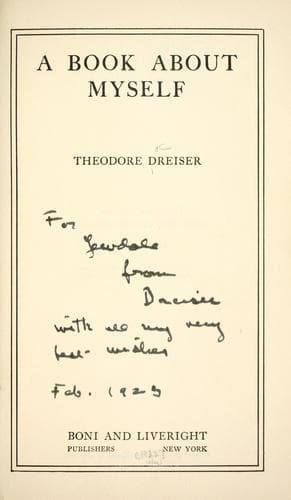
Dreiser, Theodore, 1871-1945; Journalists -- United States -- Biography; Novelists, American -- 20th century -- Biography
And he seemed to understand just how to supply that region with all it
desired in the shape of news. Though in the main the paper published
mere gossip, oddities about storms, accidents, eccentricities, still
there was something about the way the thing was done, the crisp and
brief manner in which the material was edited, which made it
palatable—very much so, I should say, to the small-town store-lounger or
owner—and nearly all had humor, naïveté or pathos. The drift of things
politically was always presented in leaders in such a way that even I, a
mere stripling, began to get a sense of things national and
international. States, the adjacent ones in particular, which supplied
the bulk of the _Globe’s_ circulation, were given special attention and
yet in such a way as not to irritate the general reader, leaving it
optional with him whether he should read or not. The editorials,
sometimes informing, sometimes threatening and directive, sometimes mere
fol-de-rol and foolery, and intended as such, had a delicious whimsy in
them. Occasionally “the old man” himself wrote one and then everybody
sat up and took notice. One could easily single it out even if it had
not been passed around, as it nearly always was. “The old man wrote
that.” “Have you read the old man’s editorial in this morning’s paper?
Gee! Read it!” Then you expected brilliant, biting words, a luminous
phraseology, sentences that cracked like a whip, and you were rarely
disappointed. The paragraphs exploded at times, burst like a torpedo; at
others the whole thing ended like music, the deep, sonorous bass of an
organ. “The old man” could write, there was no doubt of that. He also
seemed to believe what he wrote, for the time being anyhow. That was why
his staff, to a man, revered him. He was a real editor, as contrasted
with your namby-pamby “business man” masquerading as editor. He had been
a great reporter and war correspondent in his day, one of the men who
were with Farragut on the Mississippi and with Sherman and others
elsewhere during the great Civil War.
Wandering about this building at this time was an old red-faced,
red-nosed German, with a protuberant stomach, very genial, dull and
apparently unimportant. He was, as I later learned, the real owner of
the paper, the major portion of the stock being in his name; and yet, as
every one seemed to understand, he never dared pose as such but must
slip about, as much overawed as the rest of us. I was a mere underling
and new to the place, and yet I could see it. A more apologetic mien and
a more obliging manner was never worn by any mortal, especially when he
was in the vicinity of McCullagh’s office. His name was Daniel M.
Hauser. For the most part he wandered about the building like a ghost,
seeming to wish to be somebody or to say something but absolutely
without meaning. The short, stout Napoleonic editor ruled supreme.
* * * * *
Public-domain text, read in full here on John Shaqi.
Reviews
Reviews
No reviews yet
Be the first to share your thoughts on this work.
Elsewhere in the archive
Join the Discussion
Join the discussion
Sign in to leave a comment or review.
Sign InorCreate an account