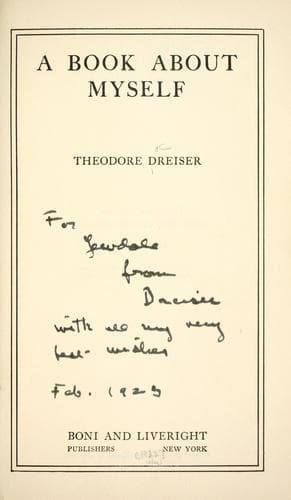
Dreiser, Theodore, 1871-1945; Journalists -- United States -- Biography; Novelists, American -- 20th century -- Biography
Just the same, in so far as this particular office and the country about
St. Louis were concerned, Joseph McCullagh was of immense significance
to his staff and the natives. Plainly he was like a god to many of them,
the farmers and residents in small towns in States like Texas, Iowa,
Missouri, Arkansas and in Southern Illinois, where his paper chiefly
circulated, for they came to the office whenever they were in the city
merely to get a glimpse of him. He was held in high esteem by his staff,
and was one of the few editors of his day who really deserved to be.
Within his office he had an adoring group of followers, which included
everyone from the managing editor down. “The chief says——,” “The chief
thinks——,” “The old man looks a little grouchy this morning—what do you
think?” “Gee, wait’ll the old man hears about that! He’ll be hopping!”
“That ought to please the old man, don’t you think? He likes a bit of
good writing.” Yet for all this chatter, “the old man” never seemed to
notice much of anything or have much to say to any one, except possibly
to one or two of his leading editorial writers and his telegraph editor.
If he ever conferred with his stout city editor for more than one moment
at a time I never saw or heard of it. And if anything seen or heard by
anybody in connection with him was not whispered about the reporters’
room before nightfall or daybreak it was a marvel of concealment.
Occasionally he might be seen ambling down the hall to the lavatory or
to the room of his telegraph chief, but most always it was merely to
take his carriage or walk to the Southern Hotel at one o’clock for his
luncheon or at six for his dinner, his derby hat pulled over his eyes,
his white socks gleaming, a cane in his hand, a cigar between his lips.
If he ever had a crony it was not known in the reporters’ room. He was a
solitary or eccentric, and a few years later, as I have said, he leaped
to his death from the second story window of his home, where he had
lived in as much privacy and singularity as a Catholic priest.
There were silent figures slipping about—Captain King, a chief editorial
writer; Casper S. Yost, a secretary of the corporation, assistant editor
and what not; several minor editors, artists, reporters, the city
editor, the business manager—but no one or all of them collectively
seemed to amount to a hill of beans. Only “the old man” or J. B., as he
was occasionally referred to, counted. Under him the paper had
character, succinctness and point, not only in its news but in its
editorial columns. Although it was among the conventional of the
conventional of its day (what American newspaper of that period could
have been otherwise?), still it had an awareness which made one feel
that “the old man” knew much more than he ever wrote. He seemed to like
to have it referred to as “the great religious daily” and often quoted
that phrase, but with the saving grace of humor behind it.
Public-domain text, read in full here on John Shaqi.
Reviews
Reviews
No reviews yet
Be the first to share your thoughts on this work.
Elsewhere in the archive
Join the Discussion
Join the discussion
Sign in to leave a comment or review.
Sign InorCreate an account