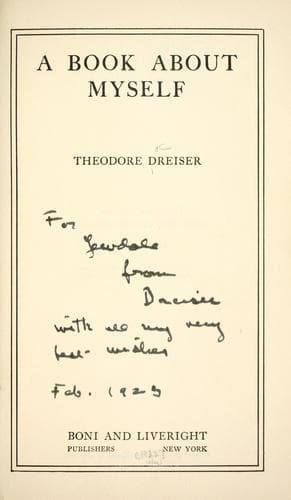
Dreiser, Theodore, 1871-1945; Journalists -- United States -- Biography; Novelists, American -- 20th century -- Biography
But this is a wandering paragraph and has little to do with “Jock”
Bellairs, except that he was of and yet not of this particular
atmosphere. The first time I saw him I felt compelled to study him, for
he seemed somehow to suggest this atmosphere to which he was appointed
as reporter. He was in a way, and yet with pleasing reservations, the
man for this task. He had a sense of humor and a devil-may-care approach
to all this. Whenever anything of real import broke loose he was always
the one to be called upon for information or aid, because he was in
close touch with the police and detectives, who were his cronies and
ready to aid him. And whenever anything happened that was beyond his
power to manage he called up the office for aid. On more than one
occasion, some “mystery” coming up, I was the one delegated to help him,
the supposition being that it was likely to yield a “big” story, bigger
than he had time for, being a court fixture. I then sought him out at
the Four Courts and was given what he knew, whereupon I began
investigations on my own account. Nearly always I found him lolling
about with other reporters and detectives, a chair tilted back, possibly
a game of cards going on between him and the reporters of other papers,
a bottle of whisky in his pocket—“to save time,” as he once amusingly
remarked—and a girl or two present, friends of one or other of these
newspaper men, their “dollies.” He would rise and explain to me just
what was going on, whisper confidentially in my ear the name of some
other newspaper man who had been put on the case by one of the other
papers, perhaps ask me to mention the name of some shabby policeman or
detective who had been assigned to the case, one who was “a good fellow”
and who could be depended upon to help us in the future.
I often had to smile, he was so naïve and yet so wise in his position,
so matter-of-fact and commonplace about it all. Sometimes he would give
me the most befuddling information as to how the news got out: he and
John Somebody or Other were down at Maggie Sanders’s place in Chestnut
Street the other night, where he heard from a detective, who was telling
somebody else, who told somebody else, and so on. Then, if there was a
prisoner in the case, he would take me to him, or tell me where some
individual or the body was to be found if there was a body. Then, after
I had gone about my labors, he would return to his card-game, his girl
and his bottle. There were stories afloat of outings with these girls,
or the using of some empty room in this building for immoral purposes,
with the consent of complaisant officials. And all about, of course, was
this atmosphere of detained criminals, cases at trial, hurrying parents
and members of families, weeping mothers and sisters—a mess.
Public-domain text, read in full here on John Shaqi.
Reviews
Reviews
No reviews yet
Be the first to share your thoughts on this work.
Elsewhere in the archive
Join the Discussion
Join the discussion
Sign in to leave a comment or review.
Sign InorCreate an account