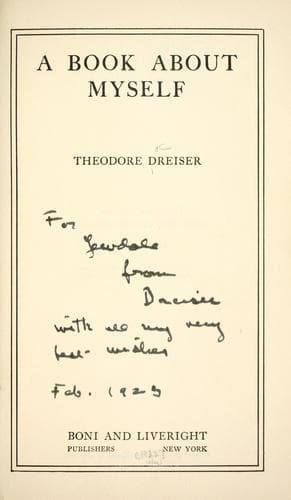
Dreiser, Theodore, 1871-1945; Journalists -- United States -- Biography; Novelists, American -- 20th century -- Biography
On an average of twice a month during my stay in St. Louis I was called
to this building on one errand and another, and always I went with a
sicky and sinking sensation, and always I came away from it breathing a
sigh of relief. To me it was a horrible place, a pest-hole of suffering
and error and trickery, and yet necessary enough, I know.
------------------------------------------------------------------------
CHAPTER XXI
I WAS walking down the marble hall of our editorial floor one day not
long after I arrived when I noted on a door at its extreme end the
words: “Art Department.” The _Globe_ in Chicago had no art department,
at least I never discovered it. The mere word _art_, although I had no
real understanding of it, was fascinating to me. Was it not on every
tongue? A man who painted or drew was an artist; Doré was one, for
instance, and Rembrandt. (I classed the two together.) In Chicago I had
of course known that each paper should have an art department, and that
interested me in this one. What were artists like? I had never known
one.
Another day I was on my way to the lavatory when I discovered that I had
come away without the key, a duplicate of which every department
possessed. The art department door being nearest, I entered to borrow
theirs. Behold, three distinctive if not distinguished looking
individuals at work upon drawings laid upon drawing-boards. Two of these
looked up, the one nearest me with a look of criticism in his eye, I
thought. The one who answered me when I asked for the key, and who
swiftly arose to get it for me, was short and stocky, with bushy,
tramp-like hair and beard. There was something that savored of opera
bouffe about him, and yet, as I could see, he took himself seriously
enough. There was something pleasing in his voice too as he said,
“Certainly; here it is,” and smiled.
The one who had looked up at first and frowned but made no move was much
less cheery. I recall the long, thin, sallow face, the coal-black hair,
long and coarse, which was parted most carefully in the middle and
slicked down at the sides and back over the ears until it looked as
though it had been oiled, and the eyes, black and small and querulous
and petulant, as was the mouth, with drawn lines at each corner, as
though he had endured much pain. That long, loose, flowing black tie!
And that soft white or blue or green or brown linen shirt!—would any
Quartier Latin denizen have been without them? He had thin, pale bony
hands, long and graceful, and an air of “touch thou me not, O defiled
one.” The man appealed to and repelled me at a glance, appealing to me
much more later, and ever remained a human humoresque, something to
coddle, endure, decipher, laugh at. Surely Dick Wood, or “Richard Wood,
Artist,” as his card read, might safely be placed in any pantheon of the
unconventionally ridiculous and delicious.
Public-domain text, read in full here on John Shaqi.
Reviews
Reviews
No reviews yet
Be the first to share your thoughts on this work.
Elsewhere in the archive
Join the Discussion
Join the discussion
Sign in to leave a comment or review.
Sign InorCreate an account