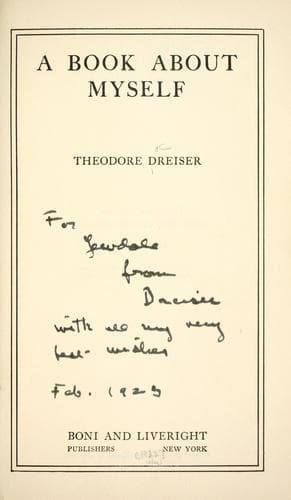
Dreiser, Theodore, 1871-1945; Journalists -- United States -- Biography; Novelists, American -- 20th century -- Biography
Spiritually he was morbid, as was I, only he showed it much more in his
manner. He had much the same desire as I had at the time: to share in
the splendors of marble halls and palaces and high places generally;
and, like myself, he had but little chance. Fresh from Bloomington,
Illinois, a commonplace American town, he was obsessed by the
commonplace dream of marrying rich and coming into the imaginary
splendors of that west end life of St. Louis which was so interesting to
both of us. Far more than myself, I am sure, he seemed to be seething
with an inward rebellion against the fact that he was poor, not included
in the exclusive pleasures of the rich. At the same time he was glowing
with a desire to make other people imagine that he was or soon would be
of them. What airs! what shades of manner! He, like myself, was forever
dreaming of some gorgeous maiden, rich, beautiful, socially elect, who
was to solve all his troubles for him. But there was this difference
between us, or so I imagined at the time, Dick being an artist, rather
remote and disdainful in manner and handsome as well as poetic and
better-positioned than myself, as I fancied, was certain to achieve this
gilded and crystal state whereas I, not being so handsome, nor an
artist, nor sufficiently poetic, could hardly aspire to so gorgeous an
end. I might perchance arrive at some such goal if I sought it eagerly
enough, but the probabilities were that I should not unless I waited a
long while, and besides, my dreams and plans varied so swiftly from day
to day that I couldn’t be sure what I wanted to do, whereas Wood, being
so stable in this, that and the other (all the things I was not), was
certain to arrive quickly.
Sometimes around dinner time when I would see him leaving the office
arrayed in the latest mode, as I assumed—dark blue suit, patent leather
boots, dark, round, soft felt hat, loose tie blowing idly about his
neck, neat thin cane in his hand—I was fairly convinced that this
much-anticipated fortune had already arrived or was about to arrive,
this very evening perhaps, and that I should never see him more, never
even be permitted to speak to him. Somewhere (out in the west end, of
course) was _the_ girl, wondrous, rich, beautiful, with whom he was to
elope and be forgiven by her wealthy parents. Even now he was on his way
to her, while I, poor oaf that I was, was moiling here over some trucky
task. Would my ship never come in, my great day arrive?
Public-domain text, read in full here on John Shaqi.
Reviews
Reviews
No reviews yet
Be the first to share your thoughts on this work.
Elsewhere in the archive
Join the Discussion
Join the discussion
Sign in to leave a comment or review.
Sign InorCreate an account