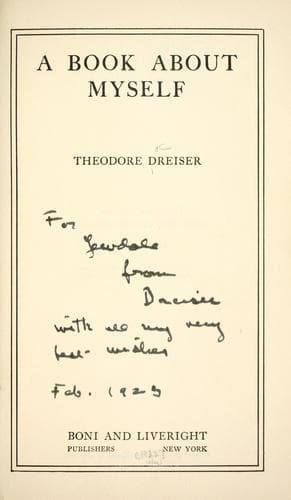
Dreiser, Theodore, 1871-1945; Journalists -- United States -- Biography; Novelists, American -- 20th century -- Biography
This visit provided a mere glance, however. When I returned the key I
was given no encouragement. A little later, my ability to write having
been fairly established, I was given a rather large order for one so
new: a double-page spread, with illustrations, for the Sunday issue,
relating to the new depot then under construction. I was told to see
that the art department supplied several drawings—one in particular of a
proposed iron and glass train-shed which was to cover thirty-two tracks.
Also one of a clock-tower two hundred and thirty-two feet high. This
assignment seemed a very honorable one, since it was to carry drawings,
and I went about it with energy and enthusiasm. It was Mitchell who told
me to look to the art department for suitable illustrations.
Evidently the art department knew all about it before my arrival, for
upon inquiry I found that P. B. McCord, he of the tramp-like hair and
whiskers, was scheduled to make the pictures. His manner pleased me. He
was so cordial, so helpful. Together we visited the depot, and a few
days later he called upon me in the reportorial room to ask me to come
and see what he had done. Having in regard to most things the same point
of view, we were soon the best of friends. A more or less affectionate
relationship was then and there established, which endured until his
death sixteen years later. During all of that period we were scarcely
out of touch with each other, and through him I was destined to achieve
some of my sanest conceptions of life. (See _Peter_. Twelve Men.)
And the amazing Wood! I have never encountered another like him,
possibly because for years I have not been associated with young people,
who are frequently full of eccentricities. A more romantic ass than Wood
never lived, nor one with better sense in many ways. In regard to
newspaper drawing he was only a fairly respectable craftsman, if so
much, but in other ways he was fascinating enough. He and McCord were
compelled at that time to use the old chalk plate process for much of
their hurried work, a thing which required the artist to scratch with a
steel upon a chalk-covered surface, blowing the chalk away from his
outlines as he made them. This created a dust which both McCord and Wood
complained of as being disagreeable and “hard on the lungs.” Wood, who
pretended to be dying of consumption, and did die of it sixteen years
later within a month of his friend McCord, made an awful row about it,
although he could easily have done much to mend matters by taking a
little exercise and keeping out of doors as much as possible; but he
preferred to hover over a radiator or before a fire. Always, on every
occasion, he was given to playing the rôle of the martyr.
Public-domain text, read in full here on John Shaqi.
Reviews
Reviews
No reviews yet
Be the first to share your thoughts on this work.
Elsewhere in the archive
Join the Discussion
Join the discussion
Sign in to leave a comment or review.
Sign InorCreate an account