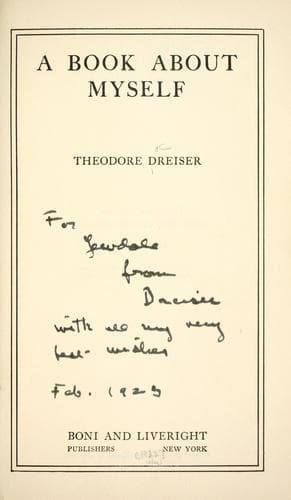
Dreiser, Theodore, 1871-1945; Journalists -- United States -- Biography; Novelists, American -- 20th century -- Biography
The discussion took the turn of book- and play-writing. He had written a
book in connection with Young, I think his name was. He had lately been
thinking of writing a play. He expatiated on the money there was to be
made out of this, the great name some playwrights achieved. Look at
Augustus Thomas now, who had once worked on the _Star_ here. One of his
pieces was then running in St. Louis. Look at Henry Blossom, once a St.
Louis society boy, one of whose books was now in the local bookstore
windows, a hit. To my excited mind the city was teeming with brilliant
examples. Eugene Field had once worked here, on this very paper; Mark
Twain had idled about here for a time, drunk and hopeless; W. C. Brann
had worked on and gone from this paper; William Marion Reedy the same.
I returned to my desk after a time, greatly stirred by this
conversation. My gloom was dissipated. Hazard had promised to let me
read this book. This world was a splendid place for talent, I thought.
It bestowed success and honor upon those who could succeed. Plays or
books, or both, were the direct entrance to every joy which the heart
could desire. Something of the rumored wonder and charm of the lives of
successful playwrights came to me, their studios, their summer homes and
the like. Here at last, then, was the equivalent of Dick’s wealthy girl!
I sat thinking about plays somewhat modified in my grief over Alice for
the nonce, but none the less aware of its tremendous sadness. I read
over my poem and thought it good, even beautiful. I must be a poet! I
copied it and put a duplicate in Alice’s letter, and folded my own copy
and put it in my pocket, close to my heart. It seemed as though I had
just forged a golden key to a world of beauty and light where sorrow and
want could never be.
------------------------------------------------------------------------
CHAPTER XXIII
THE central character of Hazard’s book was an actress, young and very
beautiful. Her lover was a newspaper man, deeply in love with her and
yet not faithful, in one instance anyhow. This brought about a Zolaesque
scene in which she spanked another actress with a hairbrush. There was
treacherous plotting on the part of somebody in regard to a local
murder, which brought about the arrest and conviction of the newspaper
man for something he knew nothing about. This entailed a great struggle
on the part of Theo to save him, which resulted in her failure and his
death on the guillotine. A priest figured in it in some way, grim,
jesuitical.
Public-domain text, read in full here on John Shaqi.
Reviews
Reviews
No reviews yet
Be the first to share your thoughts on this work.
Elsewhere in the archive
Join the Discussion
Join the discussion
Sign in to leave a comment or review.
Sign InorCreate an account