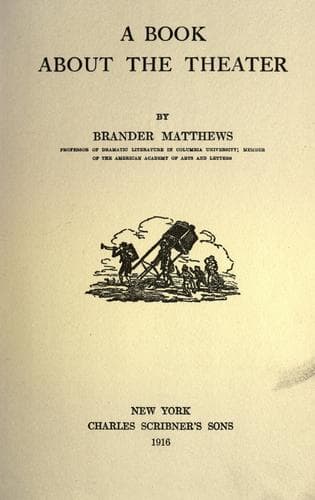
Drama -- History and criticism; Theater; Theater -- History
Here we have a true epic poem, simple yet grandiose, and possible only
to the improved shadow-pantomime of France at the end of the nineteenth
century--even if this art is only a logical evolution from the
gallanty-show of Séraphin. "This humble black profile," said Jules
Lemaître, "which had been thought fit at best of a few comic effects to
amuse little children only, has been diversified and colored; it has
been made beautiful, serious, tragic; by the multiplication of the
devices it has been rendered capable of giving us a powerful impression
of collective life, and the artists who have developed it have known how
to make it translate to our eyes the great spectacles of history and the
sweeping movement of multitudes."
(1912.)
[Illustration: _Reproduced by permission of E. Flammarion, Paris_
The Sphinx IV: The British troops to-day
From a shadow picture by Amédée Vignola]
XIX
THE PROBLEM OF DRAMATIC CRITICISM
I
It is now no longer in dispute that there has been in the past score or
two of years a striking revival of the drama in the English language,
and that there are to-day British and American playwrights who write
plays which are worth while--plays which are both actable and
readable--plays which often deserve and which sometimes even demand
serious critical consideration. This revival has necessarily resulted in
calling attention to the present condition of dramatic criticism in
Great Britain and in the United States. In a period of dramatic
productivity, dramatic criticism has an indisputable function and is
charged with an undeniable duty, both to the aspiring play-makers and to
the main body of the playgoing public. We cannot help asking ourselves
whether our dramatic critics rightly apprehend their function and
whether they properly discharge their duty; and to these pressing
questions the most conflicting answers are returned.
Some there are who insist that it is hopeless to expect the desired
outflowering of dramatic literature in our language to take place so
long as our dramatic criticism is as inadequate, as incompetent, and as
unsatisfactory as they declare it to be. Others there are who take a
more tolerant view, holding the public itself to be at fault for the
existing state of things, and who, therefore, believe that we are now
getting dramatic criticism quite as good as we deserve. Few there are
who venture to deny that there is room for improvement--altho no two of
these agree in their suggestions for bringing about a bettering of
present conditions. In the multitude of these counsellors there is
darkness and confusion.
Public-domain text, read in full here on John Shaqi.
Reviews
Reviews
No reviews yet
Be the first to share your thoughts on this work.
Elsewhere in the archive
Join the Discussion
Join the discussion
Sign in to leave a comment or review.
Sign InorCreate an account