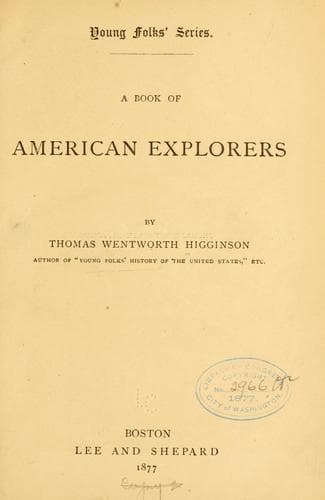
A Book of American ExplorersHigginson, Thomas Wentworth
History
A Book of American Explorers
Higginson, Thomas Wentworth
America -- Discovery and exploration; United States -- History -- Colonial period, ca. 1600-1775
These cattle were, on their arrival, first landed on Nut Island, three
miles up the river, where they remained a day or two. There being no
means of pasturing them there, they were shipped in sloops and boats
to the Manhates,[379] right opposite said island. Being put out to
pasture here, they throve well; but afterwards full twenty in all
died. The cause of this was that they had eaten something bad from
an uncultivated soil. But they went in the middle of September on new
grass, as good and as long as could be desired.
The colony was planted at this time on the Manhates, where a fort was
staked out by Master Kryn Frederycke, an engineer. It will be of large
dimensions. The ship which has returned home this month [November]
brings samples of all the different sorts of produce there. The cargo
consists of 7,246 beavers, 675 otter-skins, 48 minx, 36 wildcat, and
various other sorts; several pieces of oak timber and hickory.
The counting-house there is kept in a stone building, thatched with
reed: the other houses are of the bark of trees. Each has his own house.
The director and koopman[380] live together. There are thirty ordinary
houses on the east side of the river, which runs nearly north and south.
The Honorable Pieter Minuit is director there at present; Jan Lempo,
sheriff; Sebastiaen Jansz Crol and Jan Huyck, comforters of the sick,
who, whilst awaiting a clergyman, read to the commonalty there on
Sundays, from texts of Scripture with the comment. François Molemaecker
is busy building a horse-mill, over which shall be constructed a
spacious room, sufficient to accommodate a large congregation; and then
a tower is to be erected, where the bells brought from Porto Rico will
be hung.
The Council there administered justice in criminal matters as far
as imposing fines, but not as far as capital punishment. Should it
happen that any one deserves that, he must be sent to Holland with his
sentence.... There is another there who fills no public office: he is
busy about his own affairs. Men work there as in Holland: one trades
upwards, southwards, and northwards; another builds houses; the third
farms. Each farmer has his farm and the cows on the land purchased by
the Company; but the milk remains to the profit of the boor;[381] he
sells to those of the people who receive their wages for work every
week. The houses of the Hollanders now stand without the fort; but,
when that is completed, they will all repair within, so as to garrison
it, and be secure from sudden attack.
Illustration: SETTLEMENT ON THE HUDSON RIVER.
Those of the South River will abandon their fort, and come hither: no
more than fifteen or sixteen men will remain at Fort Orange, the most
distant point at which the Hollanders traded: the remainder will come
down to the Manhates. Right opposite is the fort of the Maykans, which
they built against their enemies, the Maquaes,[382] a powerful people.
Public-domain text, read in full here on John Shaqi.
Reviews
Reviews
No reviews yet
Be the first to share your thoughts on this work.
Elsewhere in the archive
Join the Discussion
Join the discussion
Sign in to leave a comment or review.
Sign InorCreate an account