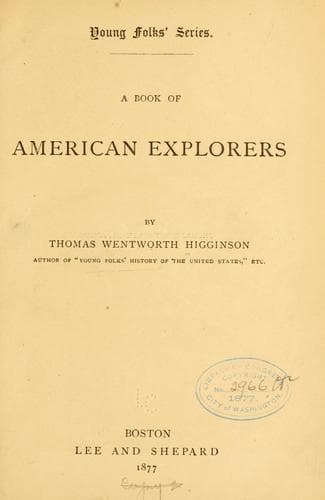
A Book of American ExplorersHigginson, Thomas Wentworth
History
A Book of American Explorers
Higginson, Thomas Wentworth
America -- Discovery and exploration; United States -- History -- Colonial period, ca. 1600-1775
301 – Sometimes called “Werawocomoco,” supposed to be on the
north side of Pamaunkee, now York River, at a place still
called “Powhatan’s Chimney.”
302 – Showy garments.
303 – Appomattox.
304 – Smith.
305 – Captain Smith, in another narrative relating to this same
period, describes Pocahontas as “a child of ten years old,
which, not only for feature, countenance, and proportion,
much exceedeth any of the rest of his people, but for wit
and spirit the only nonpareil of his country.” Nonpareil
means unequalled. But Strachey, the secretary of the colony,
gives a less poetical description of Pocahontas, describing
her as a wild and ungoverned child, playing rather rudely
about the fort with other children. See an article called
“The True Pocahontas,” in Scribner’s Monthly for May, 1876.
306 – i.e., as well skilled.
307 – Cannon.
308 – i.e., resumed our interview.
309 – Subordinate chiefs.
310 – Watch.
311 – Arrow-shot, or bow-shot.
312 – Body-guard.
313 – Ornament for the forehead, or front.
314 – An Austrian princess.
315 – Regular entertainments.
316 – Went.
317 – Compare.
318 – Gay, or frolicsome.
319 – Capable.
320 – i.e., instead of.
321 – Shoals.
322 – Confining.
323 – Eastern merchants, as the Germans and Danes.
324 – i.e., for other commodities as mean.
325 – Pollocks.
326 – Worked.
327 – Trade.
328 – Equally curious.
329 – Keep out.
330 – Smoky.
331 – Ré or Rhé.
332 – Now Chambly, Canada East.
333 – A tribe of Algonquins.
334 – Lake Champlain.
335 – The gar-fish, or bony pike.
336 – Ticonderoga.
337 – Lake George.
338 – Hudson River.
339 – Indians east of Cape Cod.
340 – Parleyed or discussed.
341 – A name given to all the St. Lawrence Indians.
342 – Sandy Hook.
343 – A fathom is six feet.
344 – Sailed to windward.
345 – Flats covered by the tide.
346 – i.e., conspicuous to approach.
347 – North latitude.
348 – Anchorage.
349 – To.
350 – i.e., did not hold.
351 – Flood-tide.
352 – They used matchlock muskets, for which a match had to be
kept burning.
353 – A small anchor.
354 – Observe.
355 – i.e., show that they knew it.
356 – Brandy.
357 – Straps, or strings.
358 – Staid.
359 – Probably near the present town of Hudson.
360 – New style. What was called the “new style” of reckoning
by the Gregorian Calendar was not adopted in England till
1753, but by the other nations of Europe much earlier.
361 – Bottle.
362 – 1611.
363 – i.e., take out part of them.
364 – i.e., while heated with excitement.
365 – At once.
366 – Henry Greene.
367 – Robert Juet, author of the Diary previously given.
368 – i.e., distributing the food.
369 – Henry Hudson.
370 – Thin pieces, cut from horn, were used instead of glass.
Public-domain text, read in full here on John Shaqi.
Reviews
Reviews
No reviews yet
Be the first to share your thoughts on this work.
Elsewhere in the archive
Join the Discussion
Join the discussion
Sign in to leave a comment or review.
Sign InorCreate an account