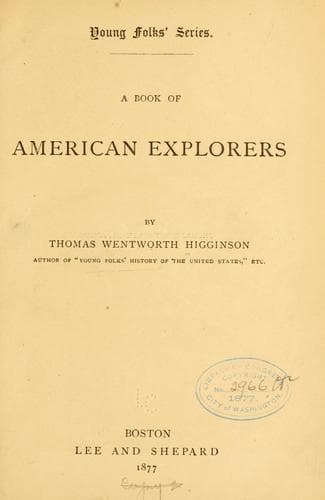
A Book of American ExplorersHigginson, Thomas Wentworth
History
A Book of American Explorers
Higginson, Thomas Wentworth
America -- Discovery and exploration; United States -- History -- Colonial period, ca. 1600-1775
371 – At the mouth of Hudson Bay.
372 – Plunder.
373 – A gun.
374 – The mutinous crew, on the ship.
375 – North latitude.
376 – Of Holland.
377 – Now Hudson River.
378 – These miles are Dutch, one being equal to three English.
379 – Manhattan Island.
380 – Trader, or shop-keeper. In German, _kaufmann_.
381 – Farmer.
382 – Mohawks.
383 – This is probably a romance.
384 – Establish themselves, as we say “country-seat.”
385 – Pamet River, Cape Cod.
386 – Sent.
387 – These guns were chiefly matchlocks, as afterwards appears.
388 – Probably at Stevens’s Point, at the western end of Cape
Cod harbor.
389 – Footprints.
390 – Probably near Stout’s Creek, opposite Beach Point.
391 – Followed.
392 – East Harbor Creek, Truro.
393 – Probably sweet-gale, or wax-myrtle (_Myrica gale_).
394 – The pond near Highland Light.
395 – Sunk.
396 – Wandering.
397 – This corn of three colors is still common at Truro.――YOUNG.
398 – This they afterwards did.
399 – Pamet River.
400 – Sapling. The word is now used only for the _sprit_
of a small sail; that is, the pole which holds it up
transversely.
401 – Rope-maker.
402 – Come.
403 – The end of Long Point.
404 – Possibly swooned, or ached.
405 – Traffic.
406 – Billingsgate Point, in Wellfleet, now an island.
407 – Entrance.
408 – In Eastham.
409 – Wellfleet harbor.
410 – Brooks; i.e., Indian Brook and Cook’s Brook.
411 – One of the dolphin family, sometimes twenty-five feet long.
412 – Great Pond, in Eastham.
413 – Lighted upon, or discovered.
414 – Boughs, or tops of young trees.
415 – Surrounded with palings.
416 – An Indian grave, where they had found corn.
417 – A flint-lock musket, then rare.
418 – Advantage.
419 – These were the Nauset Indians.
420 – Tide.
421 – Clark’s Island. It was named after the mate of the
“Mayflower,” who is said to have been the first to land
there.
422 – This was the “landing of the Pilgrims.” Allowing for the
change in the calendar, called “New Style,” it corresponds
to the 21st of December, though it was long considered
to correspond to the 22d. “New Style” means the modern or
Gregorian mode of reckoning time, which was proposed by
Pope Gregory XIII. in 1582, but not adopted in England till
September, 1752.
423 – Appoint, or propose.
424 – Guard-house.
425 – Split.
426 – Surrounded by palings.
427 – Requiring.
428 – It is still called Billington Sea.
429 – Town Brook.
430 – These houses were built on each side of Leyden Street,
which now extends from the First Church to the harbor.
431 – It was, however, an unusually mild winter.
432 – Beware of.
433 – Monhegan, an island on the coast of Maine.
434 – Ardent spirits.
435 – Mallard-duck.
Public-domain text, read in full here on John Shaqi.
Reviews
Reviews
No reviews yet
Be the first to share your thoughts on this work.
Elsewhere in the archive
Join the Discussion
Join the discussion
Sign in to leave a comment or review.
Sign InorCreate an account