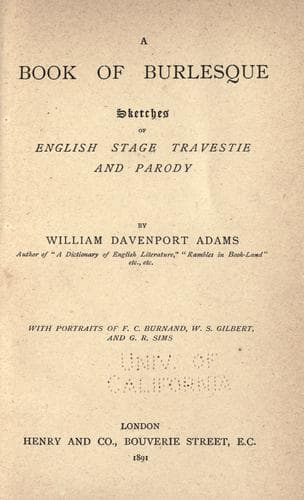
A Book of Burlesque: Sketches of English Stage Travestie and ParodyAdams, William Davenport
History
A Book of Burlesque: Sketches of English Stage Travestie and Parody
Adams, William Davenport
Burlesque (Literature); English literature -- History and criticism; Parody
It is to H. J. Byron that we owe the burlesque of "Robert Macaire,"
which, with Fanny Josephs and J. Clarke as Macaire and Strop,
brightened the boards of the Globe Theatre in 1870. The drama of which
Ruy Blas is the central figure has been twice travestied among us--once
in 1873 by Mr. Reece ("Ruy Blas Righted," at the Vaudeville), and more
recently (in 1889) by Messrs. F. Leslie and H. Clark ("Ruy Blas, or the
Blasé Roué," at the Gaiety). "Diplomacy," adapted from "Dora," appealed
to Mr. Burnand's sense of the ridiculous, and the result was "Dora and
Diplunacy" (Strand, 1878), in which the weak spots of the original were
divertingly laid bare. In the same year, Mr. Burnand burlesqued, at the
Royalty, his own adaptation, "Proof, or a Celebrated Case," under the
title of "Over-Proof, or What was Found in a Celebrated Case." To 1879
belong two clever travesties--"Another Drink," by Messrs. Savile Clarke
and Clifton (Lyne), suggested by "Drink," and brought out at the Folly;
and "Under-Proof," Mr. Edward Rose's _reductio ad absurdum_ of "Proof."
In the latter piece, besides many well-constructed puns, there are many
pleasant turns of humour, as when Pierre satirises the conventional
stage pronunciation of his name:--
In my native land, as you're aware,
My Christian name's pronounced like this--Pi-erre,
But here I'm made a nobleman of France,
For everybody calls me _Peer_ Lorance.
Of the Anglo-French melodrama of recent years, Mr. Burnand has been the
frequent and successful satirist. He capped "Fedora" with "Stage-Dora"
(Toole's, 1883), "Theodora" with "The O'Dora" (same theatre, 1885), and
"La Tosca" with "Tra la la Tosca" (Royalty, 1890). This last contained
some of the happiest of its author's efforts, in the way both of
ingenious punning and effective rhyming. Here, for example, is a song
put into the mouth of the Baron Scarpia, the "villain" both of the play
and of the travestie:--
I am the bad Baron Scarpia!
You know it at once, and how sharp y'are.
Than a harpy I am much harpier--
How harpy I must be!
There never was blackguard or scamp
To me could hold candle or lamp.
I'm equal to twenty-five cargoes
Of Richards, Macbeths, and Iagos!
For nobody ever so far goes
As Scarpia--meaning me.
I'm chief of the Italiani
Peelerini Me-tropoli-tani!
Around me they wheedle and carney--
They'd all curry favour, you see.
And, buzzing about me like flies,
Are myrmidons, creatures, and spies.
They're none of them mere lardy-dardy,
But cunning, unprincipled, hardy,
And come from Scotlandini Yardi,
La Forza Constabular_ee_.
Public-domain text, read in full here on John Shaqi.
Reviews
Reviews
No reviews yet
Be the first to share your thoughts on this work.
Elsewhere in the archive
Join the Discussion
Join the discussion
Sign in to leave a comment or review.
Sign InorCreate an account